

When we wake up in the morning to the light of the sun
You know our days won’t last forever
We could try one by one.
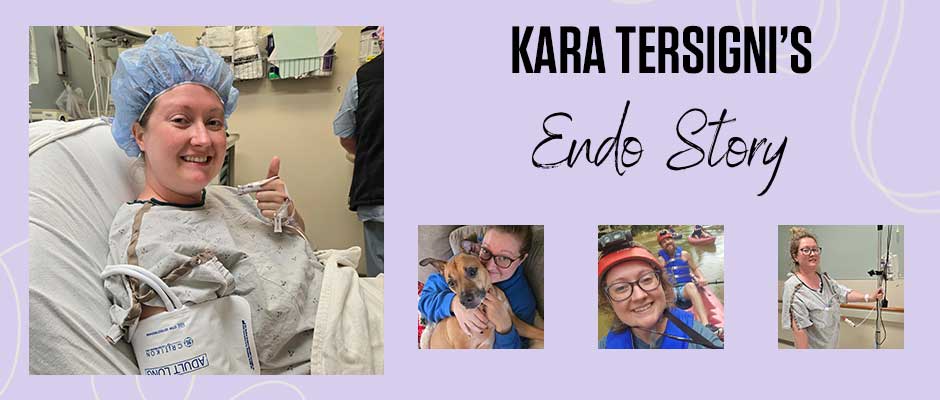
Those are lyrics to “Time and Space” by The Hip Abduction. When Kara Tersigni was in pre-op this past December, her surgeon asked her what song she wanted to listen to as she fell asleep. When he met Tersigni in the operating room, he held her hand and rubbed her shoulder as she listened to the music, calming her nerves before the most critical surgery she’d ever faced.
“It was such a different experience from my prior surgery,” Tersigni said. “I knew going in that this one would be life-changing for me in such a positive way.”
Unlike many women with endometriosis and adenomyosis, Tersigni’s most debilitating symptoms didn’t appear until just a few years ago. In retrospect, the 35-year-old thinks she had endometriosis during her teenage years, but she assumed the severe pain and heavy bleeding during her periods back then were normal. From 18 to 30, when she was on birth control (prescribed to prevent pregnancy, not to manage her symptoms), she felt pretty good.
“Everything was kind of controlled at that point. I had symptoms here and there through most of my 20s, but I never really connected them,” Tersigni said. “I had some inexplicable abdominal pain that lasted for two months and then mysteriously vanished. And for many years, I didn’t use tampons because they were painful. But I just thought that was the way my body was.”
That changed in 2021. She and her husband wanted to try to have children, so she went off birth control for the first time in 12 years.
“My body just went crazy. My hormones were all over the place,” Tersigni said. “I had hormonal acne, really bad cramps again, and intense shooting pain in my back that felt like someone was stabbing me with a knife. I had several tests done, but providers never really followed up with me.”
In 2023, Tersigni went in for a sonohysterogram, a procedure that can create images of the inside of the uterus.
“They inserted an instrument through my cervix so they could look inside my uterus, but they couldn’t get it past my cervix,” she recalled. “They said, ‘You’ve never given birth, so that’s probably why.’ I said, ‘Oh, okay.’ I was very uneducated about endometriosis at that time.”
Tersigni’s condition worsened as the year went on and continued well into 2024.
“I was waking up a day or two before my period with such intense pain that I was scrambling to eat something so I could take 800 milligrams of Motrin,” she said. “I’d also been experiencing cyclical rectal bleeding for about two years. I’d had a colonoscopy, but they said everything looked good and that a couple hemorrhoids I had were probably getting irritated and causing the bleeding. They said to just make sure it didn’t get any worse.”
When it did get worse, she saw a new doctor, who agreed that Tersigni needed more intervention. He referred her to someone with more expertise, a doctor who suspected she could have endometriosis. Given all the tests Tersigni had already undergone, he wanted to do surgery to see what he could find. That was in January 2025.
“I asked him how long the procedure would last. He said about 45 minutes, and if he found anything, he’d burn it off,” Tersigni said. “I told him that was fine, not realizing ablation was an outdated treatment method. Again, I was trusting these medical professionals.”
The procedure took three hours because the endometriosis was extensive. Tersigni’s left ovary was attached to her colon, both of her fallopian tubes were blocked, and the surgeon told her that getting pregnant was highly unlikely. He burned what he could and sent Tersigni home that same day.
“He just kind of left it at that,” she said. “He didn’t give me a stage of the endometriosis or offer me treatment options. When we asked him what we could do about the left ovary, he said we’d have to see a specialist for it because he didn’t have the skills to treat it.”
Tersigni felt some relief for a few months before the pain and other symptoms returned. In October 2025, Tersigni met with a new specialist. She knew instantly that she’d finally found the right person to treat her.
“I credit him with saving my life,” she said. “At my first appointment, he was incredibly attentive and answered all of my questions. He knew I likely had stage IV deep endometriosis and needed to have it removed. He went over other treatment options but explained why the surgery was best. When I asked if he could remove the ovary from sticking to the colon, he said, ‘Well, yeah,’ like it was nothing. I knew then that I was in skilled hands. He even gave me a card for a group on Facebook that I could join for more support.”
Tersigni’s surgery, two months later, took six hours.
“I had incredibly heavy bowel involvement that he wasn’t anticipating [which would require a colon resection at a later date],” Tersigni said. “He also removed endometriosis from both sides of my abdominal wall and did a hysterectomy after finding advanced adenomyosis. He left my right ovary and about 10 percent of my left one because I didn’t want to go into medical menopause.
“I felt very comfortable when I woke up,” she continued. “I had four incisions, and each one was covered in gauze in the shape of a heart. It was those little things he and his team did that made me feel like I was not just another number. That was so important to me.”
Tersigni recovered well. She had her colon resection last month, and the doctor confirmed that endometriosis had not returned since the December surgery.
“I don’t feel the pain anymore,” she said. “Hearing the words ‘We got it all’ was an incredible experience.”
The most difficult aspect for Tersigni post-surgery has been working through the grief of having a hysterectomy. She knew going in that it was a possibility, and it took several weeks before she felt the emotions.
“I was so focused after surgery on my physical recovery that I don’t think I allowed myself to feel all of the emotions that came with a hysterectomy,” she said. “When I did start to feel it, much of it was anger at all the people I’d trusted to take care of me who I felt failed me. It took me a long time to come to terms with the fact that it wasn’t necessarily their fault. They just didn’t know because there isn’t any education out there. They don’t teach all of this in medical school. I can’t place blame on someone for simply not knowing.”
This realization is why she’s speaking up.
“I think that changing the narrative and spreading awareness about how essential it is to see someone who is specifically trained to recognize these symptoms and treat them—that is key,” Tersigni said. “This road is long, and it’s hard, but the fight is the most important thing. Fight for yourself, and on days when you can’t, find your support and ask them to fight for you. It’s one thing to make that decision [of having a hysterectomy] for yourself, but I felt like this was decided for me considering how sick I was. It’s taken a long time to heal.”
While she knows that navigating her emotions will never be a linear process, she feels, for the most part, that she’s moved beyond the anger stage.
“I have a therapist with a chronic illness, so she is able to empathize with me and work with me on grieving and riding these emotional waves as they come,” Tersigni said. “I also have support from my wonderful husband and a wonderful job [as an office manager at a mental health clinic in Michigan] that has given me flexibility to get through this. I know I’ll have days when I’ll have to step back and be sad or angry, but then I’ll move forward from there.
“I just take it day by day.”
*Patient stories submitted to EndoFound.org are the patient's views, not necessarily those of the foundation. All testimonials are from real patients, may not reflect the typical patient’s experience, and are not intended to represent or guarantee that anyone will achieve the same or similar results.