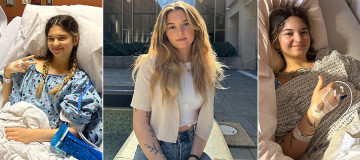


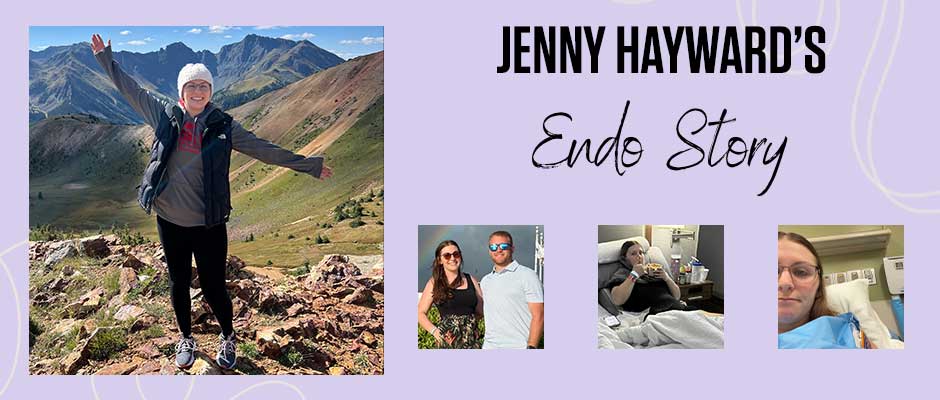
Jenny Hayward was a three-sport athlete, playing year-round for her high school and competitive club teams—all the while dealing with pain few athletes could fathom.
“Being an athlete, I’ve broken bones and have torn things, but the pain from endometriosis is a whole other level,” she said. “I can’t even describe how bad it is.”
Hayward, from Springfield, Missouri, started feeling symptoms around 2011 when she was 14 years old.
“I was put through the wringer from the start with doctors, just always told that a cyst was rupturing every month, and it was never really looked into,” Hayward said. “I was immediately put on birth control, and endometriosis was never mentioned.”
Hayward said the birth control lessened the pain enough that she could generally function day-to-day, but not entirely.
“I missed a lot of school, sometimes a few days each month,” she said. “Teachers were pretty understanding about it, but it was embarrassing to talk about because nobody wants to talk about their period at that age. It was hard to explain to some people that my period was trying to kill me.”
Hayward, who played volleyball and basketball and ran track, also missed many practices and games.
“My parents were rushing me to the emergency room so often that they’d joke that all the ER doctors knew me by my first name,” she said. “But none of the doctors could figure out what was going on. I was so confused and lost. It was very sad and took a big part of my life away.”
The struggle was as much mental as it was physical.
“My parents explained to my coaches what was going on, and they seemed to understand, but it was still so hard because I was worried that my teammates wouldn’t believe me,” Hayward said. “My symptoms weren’t the kind that usually sideline an athlete, something that anybody could see, like a twisted ankle or broken bone.”
Hayward stayed on the pill in high school, college, and graduate school, pushing through the pain at every turn. She stopped taking it when she got married at 24.
“I was okay for a while, but then all hell broke loose,” she said. “The pain returned and with a vengeance, and now I had new symptoms with my bladder and bowel. But it was the pain more than anything. It felt a hundred times worse than it ever had and was causing me to miss a lot of work. I was burning through sick days pretty fast.”
Hayward went to her OBGYN, who told her to double the dose of naproxen she was already taking.
“He didn’t seem concerned at all,” she said. “He made me feel like this was just how my body was with periods and I had to deal with it, so I accepted it.”
Over time, Hayward’s symptoms worsened. She eventually researched her symptoms, learned about endometriosis for the first time, and was convinced she had it. She made another appointment with her OBGYN and demanded an ultrasound. After initially being rebuffed, he agreed to do it and discovered an endometrioma on her left ovary the size of a grapefruit.
“He made me feel completely confident in doing surgery with him,” she said. “I asked him if I needed to see a specialist or get a second opinion, and he told me no. I couldn’t live another month with the pain, so I agreed to the surgery.”
This was in early 2025. Hayward said the surgeon used ablation to remove the cyst and endometriosis that he found in several places, including on her bladder, colon, and bowels. EndoFound cofounder Dr. Tamer Seckin does not recommend ablation for treating endometriosis. The method burns the disease rather than excising it at the root. It can also lead to significant scar tissue.
“He looked me in the face after the surgery and told me he got it all,” Hayward said. “At that point, I was very naïve and didn’t know then what I know now.”
In fact, the surgery did not alleviate her symptoms, and her OBGYN said there was nothing more he could do. Hayward spent the next few months searching for answers from various medical professionals before a pelvic floor therapist, who also had endometriosis, recommended her to an endometriosis excision specialist in Dallas. Hayward’s first appointment was virtual.
“She was incredible. Phenomenal. It was the first time I’d felt listened to and validated by a doctor,” Hayward said. “She explained how that first surgery probably didn’t get everything and that I needed excision surgery.”
Hayward made the 400-mile trip to Dallas for surgery in October 2025.
“She found that it was stage IV,” Hayward said. “It was inside my bladder, which she said is very rare and indicative of how severe it was. She also found my colon stuck to my uterine wall and had to remove my appendix and left fallopian tube. It was also inside my uterus, all over my bowels, and starting to get on my ureters, which could have given me kidney problems if it had continued.”
Hayward said that following surgery, the doctor told Hayward’s husband that it was one of the most aggressive cases of endometriosis she’d ever seen. “She told him, ‘I don’t know how she has remained as functional as she has for as bad as it was. She’s tough,’” Hayward said.
Hayward had two goals with the surgery. The first was accomplished. “My periods have improved significantly, and all of my symptoms are either nonexistent or barely there,” she said. “I’m doing great.”
The second was to preserve fertility. “My husband and I don’t have a family yet but want to start one,” she said. “For the first time, I’m feeling hopeful that we’ll be able to.”
The successful surgery also led to a third goal: bringing awareness to the disease.
“It’s something I’m very passionate about. After I posted about it on social media, a lot of people reached out to me, and a lot of them didn’t even know endometriosis was a thing,” Hayward said. “I’d even like to take it a step further and contact local representatives, senators, and even [U.S. Secretary of Health and Human Services] Robert Kennedy to bring more awareness. There has to be change.”
Hayward encourages women to advocate for themselves.
“People need to know how common this is,” she said. “So many of us are gaslit into thinking that what we’re experiencing is normal or not a big deal. It’s not normal, and it is a big deal. Don’t be afraid to keep asking questions until you get answers.”
*Patient stories submitted to EndoFound.org are the patient's views, not necessarily those of the foundation. All testimonials are from real patients, may not reflect the typical patient’s experience, and are not intended to represent or guarantee that anyone will achieve the same or similar results.