

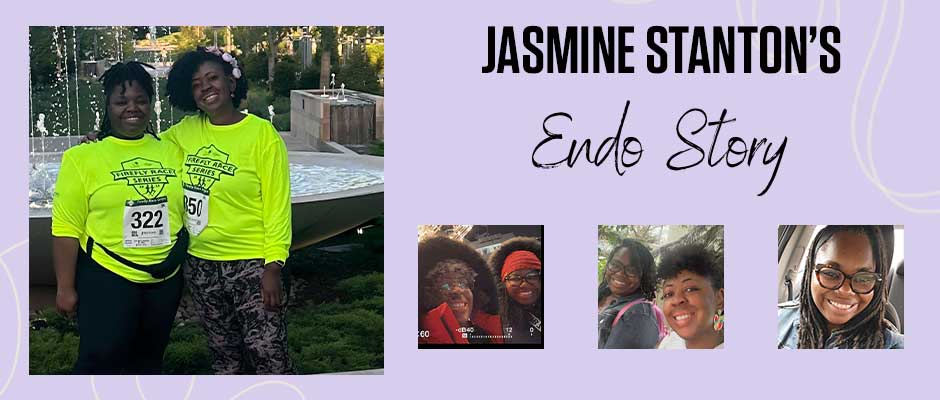
Jasmine Stanton’s cycle started 26 years ago when she was just nine years old, and so did the pain. Excessive bleeding, nausea, and fatigue soon followed and remained constants in her life. Missing school was usually not an option.
“I had to tough it out. I was popping Advil and Motrin back to back and just dealing with it,” Stanton said. “I remember my mom taking me to my pediatrician when I was in elementary school because of the bleeding and pain, and my pediatrician suggested I start a low dose of birth control, but my mom was completely against it.”
Stanton came from a home where menstrual cycles weren’t discussed, and what little she learned in her pediatrician’s office that day was about the extent of her menstrual education.
“I didn’t see my first OBGYN until I was 25, when I went on my own,” she said. “All I’d been taught was pretty much how to use sanitary napkins and keep yourself clean, but I didn’t know what a cycle was supposed to feel like or look like.”
When Stanton got to high school, she was going through a lot of sanitary products to prevent bleeding through her clothes, and the pain had become nearly unbearable.
“There were quite a few times when the pain was so bad that I became nauseous and threw up,” she said. “One time, I called my mom from school and asked her if I could go home. Being a single mom and working, she couldn’t get me, and I was in too much pain to walk, so the school security guard gave me a ride. When I got into the house, I immediately fell onto the floor. I eventually got up and went to bed, but then I had to go to school the next day. I just had to put on a face and tough it out.”
She kept that attitude in college, where she earned her certification as a nursing assistant. It was during a 12-hour shift at a hospital in 2016 that she became convinced there was nothing normal about her period.
“Everything went bad that day. My cycle had started, I was nauseous and in a whole lot of pain, and my abdomen hurt, but we can only call off so many times in a year. I had to go in,” she said.
By the time Stanton got to work, the bleeding was so heavy that it had gone through her scrubs. She ran to the bathroom, rinsed them, and started work.
“As the day went on, the pain and nausea increased to where I could barely walk through the hallway without a nurse asking me if I was okay,” she said. “When it got close to the end of my shift, I ran into my manager’s office because it was closer than the bathroom, and I immediately threw up. The pain felt like someone was carving me with a knife.”
When Stanton got home, she searched for an OBGYN and found her first one. She went in, went through a series of tests, and was diagnosed with fibroids and anemia. She was put on birth control and told to lose weight.
“Nobody brought up surgery at all,” she said.
In 2018, with birth control proving ineffective and visits to the emergency room becoming frequent, Stanton had to quit her job because she was no longer physically able to do it. She described the bleeding during her periods as “like a waterfall,” and she eventually had to have a blood transfusion. Aside from that, she said, she was offered no viable solutions and was sent home each time.
When Stanton returned to her OBGYN, she was given a referral to a surgeon who performed an MRI and concluded that she had several fibroids and some endometriosis.
“They didn’t explain what that was, and I had no idea what it meant,” she said. “He just told me that if I wanted to have kids, I should lose 50 pounds, have a kid, and then they would do surgery.”
Stanton continued down a road of pain, heavy bleeding, and uncertainty for several years. She often felt isolated, angry, and depressed. One OBGYN and surgeon after another offered little beyond birth control, ineffective pain medications, or misdiagnoses, such as IBS. She eventually reached a point where she couldn’t leave her house because the bleeding was too heavy and frequent. The pain had stretched to her lower back, hips, and legs. This continued until last year.
“By then, I felt like a slaughtered pig,” she said. “I refused to take any more birth control, and if I had to almost die to get someone to listen, then that’s what was going to happen. It really reached a point where I felt death would have been better. Nothing was working. I can’t tell you how many prayers I prayed.”
After a few more referrals from one doctor to the next, Stanton found a surgeon in 2025 who agreed to operate.
“I was shocked,” Stanton said. “It was the first time I’d been given a solution other than birth control.”
The surgery was in March. Stanton was diagnosed with fibroids, adenomyosis, and stage IV endometriosis. The surgeon removed eight fibroids from her pelvic region and rectum, an ovarian cyst, and endometriosis from several organs that were stuck together.
“I can’t even describe how much better I feel today,” Stanton said. “Now I can walk up to eight miles without any pain, and I can do it without any pain meds or having to sit down.”
She said she experienced a wide range of emotions when she woke up from surgery and doctors told her what they had found.
“I felt relieved, validated, but also angry,” Stanton said. “Maybe if there had been a bigger push when I was young, more education, something could have been done for me sooner. It’s just not normal for someone that young to be experiencing all of those issues.”
Stanton said she’s leaned on a Bible passage—Mark 5:25-34—to help her through her journey. The verses describe a woman who had been bleeding for 12 years. After touching Jesus’ garments, the bleeding immediately stopped, and she was freed from her suffering. Jesus told her that her faith had healed her.
“It’s something that is very fitting for my story and maybe will provide a little hope to others,” Stanton said.
She encourages all young girls to keep the faith and to stand up for themselves when something doesn’t feel right.
“When you get your first cycles, don’t feel shy or ashamed—learn what’s going on with your body,” she said. “If your parents can’t provide you with information, find an adult you trust who can. Or use your phone or computer to research. It’s not normal to be in elementary school and bleeding like that and in pain. It’s not normal for any woman to be that way. You will have doctors who will dismiss you, but know that you’re right and that you don’t have to accept what they say. Trust in the mind and body God gave you!”
*Patient stories submitted to EndoFound.org are the patient's views, not necessarily those of the foundation. All testimonials are from real patients, may not reflect the typical patient’s experience, and are not intended to represent or guarantee that anyone will achieve the same or similar results.