

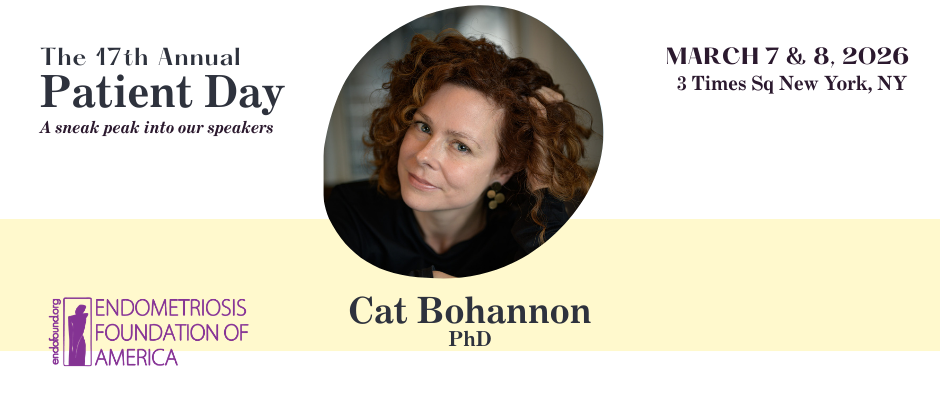
New York Times best-selling author Cat Bohannon isn't surprised to find herself speaking to the endometriosis community for EndoFound’s Patient Day. In fact, she believes endometriosis research is key to better understanding bodies everywhere. "Studying endo unlocks this Pandora's box of unanswered questions about the body in ways that help literally everyone, not just people with endo," she says.
Many people living with endometriosis are already well aware of the gaps in research, treatment, and disease education. Bohannon is, too, and her work explores the complicated reasons behind this reality.
Though she doesn't have endometriosis herself, she knows many who do. She is quick to point out that, "As we're increasingly finding, [endo] is not nearly as rare as we used to think and that's because of underdiagnosis and delayed diagnosis."
Both continue to massively impact the experiences of endometriosis patients. For much of medicine, women's bodies were thought of as less important to study than men's bodies. Clinical trials conducted in the US were not required by law to include female participants until 1993. Patients everywhere are still affected by these significant gaps in research, and conditions like endometriosis that affect women and people born with a uterus are still underfunded.
Bohannon believes that endometriosis research will illuminate other corners of medicine, as well. For example, "The endometrium itself is a really good place to look at how metastasizing works. All of oncology really needs to care about the uterus. You [endometriosis patients] matter for way more than just you."
As a theorist, much of her work explores the intersection between sex, gender, and medical research. Bohannon's debut, Eve: How the Female Body Drove 200 Million Years of Evolution, which Knopf published in 2023, contends that the experience of healthcare for all people is influenced both by biological sex as well as societal constructs of gender.
Sex and gender, though not the same, come together in the clinical setting to influence the care patients receive. "Gender is a big part of that neglect story. Gender is a big part of why your pain is disbelieved in the clinic. Why you're not diagnosed for a decade? A combination of sex and gender, I think. You have a setting where clinicians are underprepared because of a lack of knowledge which is not their fault."
Bohannon's forthcoming book, Being Alive: The New Science of Female Health and Why It Could Save Us All, examines the female body across the lifespan and illuminates the many research areas requiring further study. "One of the things that's really great about writing this [next] project is that my topic space is the average female human lifespan, so roughly 80 years. The last [book] was 200 million, so this feels much more manageable," Bohannon says.
One of her key interests is the cumulative effects of the mortality/morbidity paradox. This concept aims to explain the gender-based phenomenon wherein women have worse health but live longer than men on average. Women more often spend their lives managing chronic conditions, which in turn impact every part of the body.
As Bohannon posits, "To what degree is that mortality/morbidity paradox shaped by a lifetime of neglect in research and the clinic?"
Bohannon argues that in order to have a complete picture of the experience of women's health, though, we must also look at the social conditions we are steeped in. Due to the nature of her research and writing, she has become convinced that there isn't a neat separation between individual health and one's environment. Not acknowledging the social impacts of health can contribute to misconceptions about the body in general.
Just one of many examples Bohannon has recently been exploring in her research? Divorce. "The median age of divorce is in the 40s. That doesn't port to all experiences of partnering throughout the world, but it's true here and true in a lot of Europe and parts of Eastern Asia. So I'm like, well, I have to talk about the health impacts of divorce."
The lived experience of having endometriosis throughout a lifetime is equally as important to study as the social impacts of health. After all, it's a condition that affects patients beyond menstruation. Living with endometriosis affects everything from relationships to career goals.
Bohannon is fueled by a passion for advocacy. She readily identifies it as a core part of who she is, and dates her passion for activism back to her work organizing AIDS marches in the 1990s. Now, she feels honored to have the privilege to use her work to bring awareness to many groups in need of a larger platform. "We all hope to be involved in work that's bigger than us. I feel really lucky to be involved in work that's bigger than me."
You can hear Cat Bohannon speak about her work and the importance of endometriosis research at EndoFound's Patient Day on March 7. Tickets are available for purchase at https://www.endofound.org/patientday.