

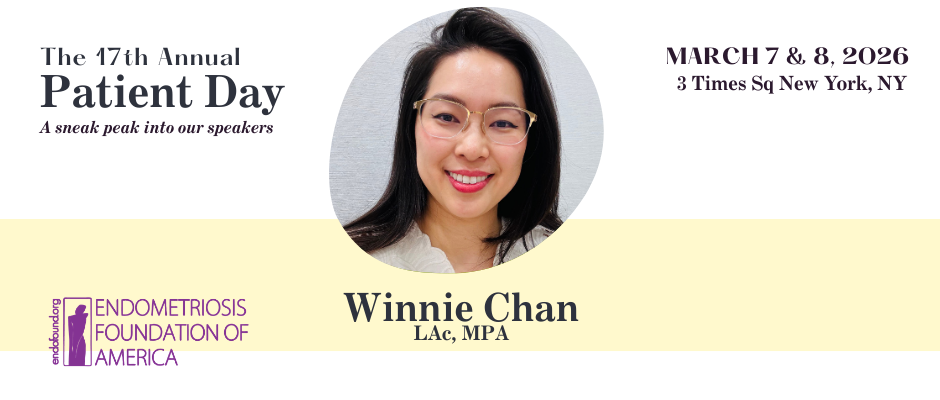
As part of our Patient Day Spotlight Series, we're delighted to spotlight Winnie Chan, who will be speaking on the benefits for endometriosis patients of acupuncture and Traditional Chinese Medicine on Sunday March 8th. Register for the 17th Annual Patient Day today.
You may associate acupuncture solely with pain relief, but it has many more applications, particularly for endometriosis patients. At EndoFound’s upcoming Patient Day, participants will hear from Winnie Chan, a licensed acupuncturist based in SoHo, New York City, who specializes in women’s health with a deep focus on endometriosis, pelvic pain, fertility support, hormone balance, and nervous system regulation. In her session, Chan will explore how acupuncture and Traditional Chinese Medicine (TCM) can support endometriosis care, especially through nervous system healing.
Chan, who underwent eight extensive surgeries involving the bladder, kidney, rectum, bowels, and diaphragm, is an endometriosis patient herself. “I know firsthand the physical pain, emotional exhaustion, uncertainty, and isolation that often come with living with this debilitating disease,” she explains.
Her endometriosis journey led her to TCM, with acupuncture being a turning point in her recovery. “It helped regulate my nervous system, reduce my pain, and ultimately allowed me to regain mobility after pelvic nerve damage, when I once needed a cane to walk,” Chan says.
For those unfamiliar with acupuncture, Chan describes it as a medical therapy that uses thin, sterile needles to stimulate specific points in the body. “These points influence circulation, nerve signaling, and the body’s natural healing mechanisms,” she says. “From a modern scientific standpoint, acupuncture helps regulate the nervous system, reduce inflammation, increase blood flow, and modulate pain pathways in the brain. It also lowers stress hormones and releases endorphins, which naturally reduce pain.”
From the TCM perspective, endometriosis is most commonly understood as a condition of Qi and blood stagnation, particularly in the pelvis region. “In simple terms, this means circulation—both physical and energetic—is not flowing smoothly,” Chan explains. Rather than focusing on a single lesion or organ, TCM evaluates the entire system, making it a complementary approach to Western medicine.
In this framework, Chan emphasizes that both acupuncture and herbs are needed, so working with a practitioner trained in both is key. “Acupuncture helps move Qi, while customized herbal formulas help move blood,” she says.
Acupuncture is not solely about where each needle is placed. Practitioners are assessing sleep patterns, digestion, stress levels, menstrual cycle history, energy, emotional well-being, and overall nervous system state. “In TCM, we also use tongue and pulse diagnosis to understand deeper internal patterns,” she says. Treatment typically begins with weekly sessions, especially in the beginning, as the goal is not simply short-term pain relief, but also retraining the nervous system and restoring healthy circulation over time.
Endometriosis pain, Chan explains, is deeply connected to nervous system sensitization. “Many patients live in a chronic fight-or-flight state due to ongoing pain, trauma, and stress,” she says. Acupuncture helps shift the body into a parasympathetic, or “rest-and-heal,” state. “It reduces stress hormones, calms overactive nerve pathways, and helps reset how the brain processes pain signals.”
“In many ways, acupuncture acts as a form of neuromodulation, helping the body relearn safety,” she continues. “When the nervous system feels safer, inflammation decreases, muscle tension releases, and pain perception often significantly improves.”
Endometriosis is a chronic inflammatory disease that affects more than the reproductive system. “It affects the nervous system, immune function, hormones, digestion, and mental health,” says Chan. Acupuncture, in turn, works on multiple systems at once: improving pelvic circulation to relieve pain and reduce inflammation, regulating the nervous system to calm central sensitization, supporting hormone balance, strengthening digestive function, and aiding in emotional regulation.
In her Patient Day session, “How Does Traditional Chinese Medicine & Acupuncture Support Endometriosis Pain Management?”, Chan will share both clinical insights and education on how acupuncture activates the vagus nerve to promote full-body relaxation, which is a key component in managing chronic pelvic pain. “My goal is to empower both patients and healthcare providers with practical, compassionate knowledge about how integrative care can support long-term healing and quality of life.”
Register for the 17th Annual Patient Day today. Tickets are $50 for each day, or $50 total for the virtual event. Patients who would also like to attend the Medical Conference on Friday, March 6, can do so for an additional $50. For more information and to register, visit www.endofound.org/patientday.