

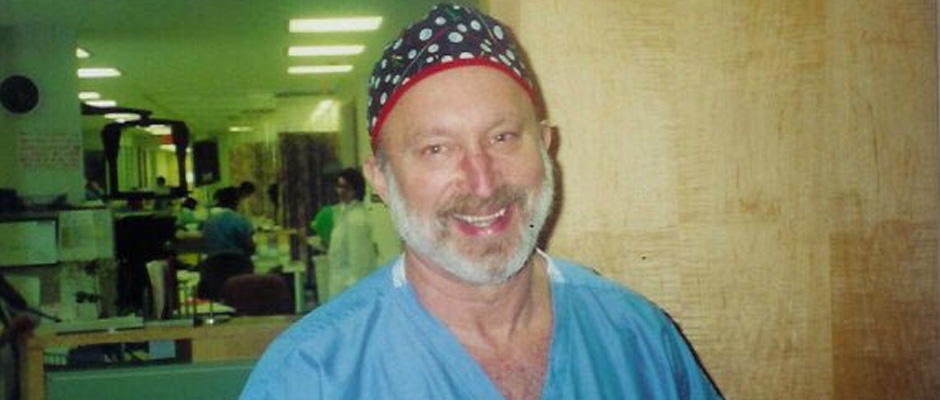
In January 1988, a group of faculty and students from Tufts Bay State Medical Center in Springfield, Massachusetts, drove four hours southwest one day to observe Dr. Harry Reich in action. Dr. Reich was a gynecologist with a practice in Kingston, Pennsylvania, who knew one of the faculty members.
“Tufts would send a team every month to watch me,” Dr. Reich shares. “I had three cases booked that day, and two canceled. The one I still had was a hysterectomy, and my plan was to start it laparoscopically and finish it vaginally [without a laparoscope] so they could see my skills both ways. But since I only had one case and they’d come all that way, I thought, What the heck, I’ll show them how to do it all laparoscopically.”
The following year, after being rejected by several prominent medical journals, Dr. Reich’s paper on the surgery—the first laparoscopically-assisted vaginal hysterectomy—was published by the Journal of Gynecologic Surgery. Dr. Reich shares that the publication was “a big event in gynecology” in the U.S. and Europe, which still makes him smile. Not so much because of the accomplishment, but because it wasn’t the first time he’d done it.
“I’d been doing that type of surgery for years before I received acclaim,” he says, later recalling that he started doing laparoscopies around 1978. “I was in a small town with a team I’d worked with for a long time, and I don’t think any of us thought what we did was a big deal. It wasn’t until someone told me after that surgery that I should publish it that I decided to do so.”
“Dr. Reich is a mentor to so many of us,” Dr. Tamer Seckin, co-founder of the Endometriosis Foundation of America (EndoFound), says. “I cannot imagine a single person who has done more for endometriosis care.”
In honor of Dr. Reich’s illustrious career, Dr. Seckin established the Harry Reich Award in 2010. Presented at EndoFound’s annual medical conference, the honor “recognizes endometriosis specialists and scientists who are making a difference in patients’ lives through their practice, research, and advocacy efforts.”
This year’s award will be conferred at the conference on March 6 and 7 in New York City to the two keynote speakers, Assia A. Stepanian, MD, and Sun-Wei Guo, PhD. Dr. Reich and Dr. Seckin will present it to them.
Dr. Reich, retired and living with his wife in Atlanta, is EndoFound’s Honorary Medical Director Emeritus. The former marathon runner and triathlete spends time each day exercising, reading, keeping in touch with those he worked with or mentored, and staying apprised of world events. That includes following the ever-evolving medical technology, especially with regard to endometriosis.
“The biggest advancement in the last 10 years has been with robotics. What I did is almost a lost art,” Dr. Reich says. In a recent discussion with a doctor he trained, Dr. Reich said the doctor noted how much robotics is used today and will continue to advance.
“He said to me, ‘In your day, you had to be skilled to avoid cutting into the rectum or cutting into the ureters, but in the future, the robot will tell the surgeon where to cut or not to cut,’” Dr. Reich said. “In my day, you had to really know your anatomy. Today, you don’t. As a result, most gynecologists today cannot operate through the laparoscope alone. They have robot help. That’s one way things have progressed.”
Dr. Reich was born in 1941 in Wilkes-Barre, Pennsylvania. He followed in the footsteps of his parents, who were both medical doctors. Dr. Reich graduated from Lehigh University in 1964 and from the Royal College of Surgeons in Ireland in 1970. He went through advanced residency programs to sharpen his surgical skills before opening his practice in Kingston in 1976.
Along with performing the first laparoscopically-assisted vaginal hysterectomy, Dr. Reich is credited with the first pelvic lymphadenectomy for cancer and the first excision of cul-de-sac endometriosis that included rectal resection. Through his more than 4,000 gynecologic laparoscopy procedures, he was also one of the first doctors to laparoscopically excise deep fibrotic endometriosis, and he introduced minimally invasive techniques for the treatment of tubo-ovarian abscesses, thereby reducing the need for hysterectomies.
A significant turning point in Dr. Reich’s career was in 1983, when he made a conscious decision one day not to perform any more incisional surgeries. Every surgery from that day forward would be through a laparoscope.
“I was in Boston and had an old friend there where I trained, and he showed me his camera system. He took pictures of all his cases,” Dr. Reich said. “After seeing that, I ordered my own, and when it arrived, I was finally able to prove what I did. Until you have a camera system, you can say what you did, but nobody believes you. All of a sudden, I had documentation of everything.”
And from that decision in 1983 came the accomplishment for which he is most proud as he reflected on his career. No, not the recognition he would receive five years later for performing the first laparoscopically-assisted vaginal hysterectomy, or any of the other milestones for which he’s been publicly recognized.
“When I think back to when I started, a hysterectomy was a big operation that always meant a week in the hospital. We shortened that to a day through laparoscopy, “ he shares, a feat that has since not only saved the healthcare system a significant amount of resources, but also ensured less invasive and more manageable healing for endometriosis patients everywhere—both Dr. Reich’s own and the many patients who have been treated by surgeons and students Dr. Reich both trained and continues to influence.
To attend the medical conference and have the opportunity to meet Dr. Reich, visit www.endofound.org/medicalconference. To learn more about the Harry Reich Award, including seeing a list of past winners, visit www.endofound.org/medicalconference/harry-reich-award.