

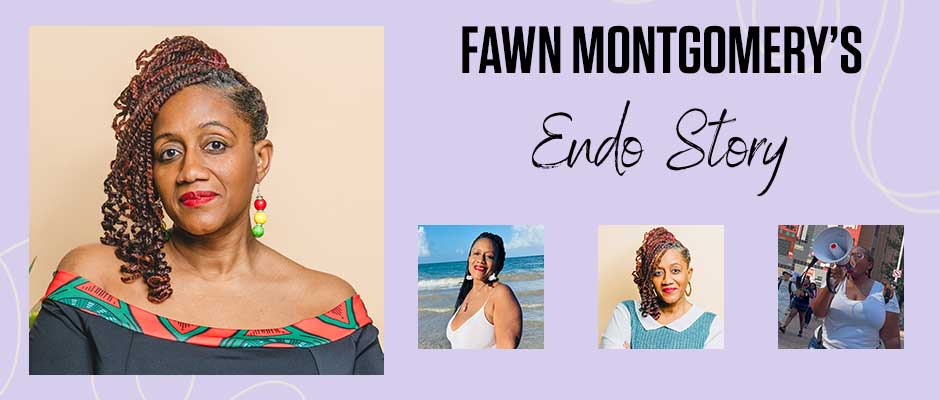
My endometriosis story began at the age of 11 when I got my period, and remains inseparable from my work in activism and advocacy. I had my first gynecological exam and was on birth control before I turned 16. But it was in the 9th grade that I staged my first protest through menstrual pain.
My Black classmates and I wanted a Black history class and a Black History Month celebration beyond learning about the same people like Martin Luther King and Rosa Parks. When we presented the idea, there was resistance from the school administrators.
On the day of their scheduled Black History program, I decided to protest by collecting signatures on a petition. I had PMS, and the pain from my cycle was starting to brew. When I woke up for school, I took a Tylenol as a preventative measure. I packed my crackers and grapes for the nausea, and because I had already trained myself to work through the pain, “suck it up” had become my mantra. My classmates and I stood in front of the auditorium door to block the entrance, and we asked for signatures for our petition.
Meanwhile, the endometriosis pain I was experiencing felt like somebody was stabbing me in my stomach and lower back with a small knife. Every time I felt that pain, it made me angry. That day, I used this feeling to drive my passion, and continued to do so every day I advocated for something I believed in. I was already angry at the racism I was experiencing, and my physical pain gave me the language to express the anger for what I was protesting about. My pain was a physical reminder of the pain we as students were experiencing with no relief. Thinking back, I liken this experience of ignoring my pain and pushing through the symptoms as a tool of white supremacy. I sacrificed myself to work through pain to help my people.
Our protest, of course, upset the administration. They removed us from the assembly, took us to the office, and called my parents. When they came to pick me up, my parents looked at the administrators and said, “Good for her.”
My mother, who, like me, also suffers from endometriosis, always shared with me her wisdom about self-advocacy. Over the years to follow, I often found myself fainting, nauseous, and rushing to the emergency room. After giving birth to my daughter at 24, I was met with more pain and the cramps became unbearable. Together, my mother and I insisted on a diagnosis, and after enduring the invasive procedure of a laparoscopy, I learned in 2005 that I had endometriosis. At that time, no doctors told me that endometriosis could progress. Instead, they offered more birth control and said I may have trouble getting pregnant again.Whenever I revisited them with my ongoing pain complaints, the response was always to suggest a hysterectomy. I continued to deal with the indescribable pain and other symptoms. For me, this looked like intense pain mostly in my stomach, nausea and fainting spells.
To distract myself, I leaned into community activism, becoming a well-known activist and politician.I continued to advocate for myself with my doctors; however, this typically resulted in me being ignored, gaslit, and overlooked. I remember one doctor telling me, “I know you; I see you on TV. You're strong; you can handle this. This doctor would also tell me, “Black women can take pain,” in addition to the insinuation that this pain was all in my head, which only compounded the issue.
During this time, I met and married my husband. We faced the challenge of trying to conceive with endo. Despite numerous D&Cs and constant visits to various specialists, again no one ever mentioned that endometriosis could be a full-body disease. My pain persisted, and I found myself repeatedly in the emergency room, where I was diagnosed with diverticulitis, leading to antibiotics that did little to address my pain.
In 2021, everything came to a head. I felt a sudden, intense pain on my right side that caused me to pass out. I went to the ER and received no answers, only strong pain meds. This went on for months and I was taking 5 to 10 Tylenol daily.
Growing frustrated, I started to do my own research, cut back on work and set boundaries. After another gynecologist misdiagnosed my situation as an STD, I demanded to see an endometriosis specialist. In a brief ten-minute consultation, he diagnosed me with stage 4 endometriosis, which had already spread to my rectum and pelvis.
As a Black woman I felt all the things hearing this news. The racist medical gaslighting and ignoring my pain had stolen my ability to have children with my husband, and now my uterus. I made the difficult decision to have the hysterectomy.
While I understood this wouldn’t be a cure, my quality of life was low. In addition, I was experiencing suicidal thoughts at this time as well. The procedure was seven hours. An abscess exploded and my bladder was nicked. I woke up with a catheter inserted The doctors said this was one of the worst cases of endometriosis they'd encountered.
After the surgery, the pain somewhat improved, easing slightly from a pain level of 100 to 45. However, my body was then thrown into surgical menopause, which causes hot flashes and brain fog. This ordeal prompted me to continue my healing journey. I committed to holistic practices rooted in an African form of spirituality called Hoodoo where I focused on wellness, saw food as medicine, and connected with my ancestors.
A year passed, and though I initially experienced some relief, the pain returned. This led to more tests and outpatient procedures that revealed a slow-moving colon and endometriosis on my right pelvic area. As reminders of my struggle surfaced, I grappled with the reality that I still had the disease in my body. Not to mention the invasive procedures that at times left me feeling medically violated.
However, this time I began to advocate for myself in a different way. I prioritized my own needs through practicing radical self-care and continued holistic methods such as meditation, CBD, and sound healing to manage my symptoms. I’m currently working with a doctor who supports me in using natural methods alongside some forms of Western medicine to create a more balanced treatment plan and manage my pain.
Now, my pain is more manageable, and my recent dietary changes have been beneficial. I recognize that these methods may not work for everyone and I encourage others to advocate for themselves and explore options that fit their individual needs, whether they are a student activist in the ninth grade or an adult. It's particularly important for Black women to prioritize their health and well-being. I can firmly say that if I hadn’t advocated for myself throughout this journey, I would not be here today.
*Patient stories submitted to EndoFound.org are the patient's views, not necessarily those of the foundation. All testimonials are from real patients, may not reflect the typical patient’s experience, and are not intended to represent or guarantee that anyone will achieve the same or similar results.