

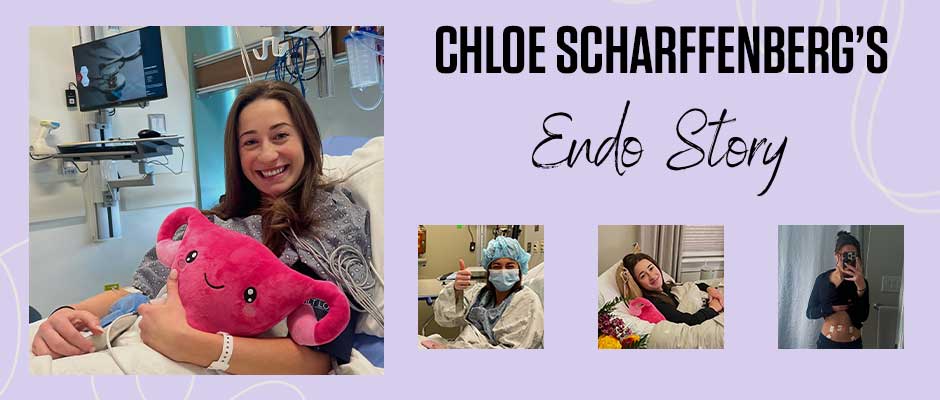
Chloe Scharffenberg has had three endometriosis surgeries in the last five years. She will have a colonoscopy and endoscopy next month to determine if the disease is affecting other areas of her body. The last two surgeries were excision, considered the gold standard for treating endometriosis. Still, the disease has been relentless.
“The pain is so severe in my legs and back that a lot of times I faint and throw up, and I’m on the pill and have an IUD, but I still experience pain and bleeding frequently,” Scharffenberg said. “The fatigue is also a big problem, and I often get large cysts that are painful to the extent that I can’t walk or sleep.”
Scharffenberg, 25, lives in East Boston and works as a developmental specialist for babies under three with developmental delays. At the same time, she’s pursuing her master’s degree in social work. The balancing act of living her life while dealing with incessant pain began when she was 14.
“I was a freshman in high school when it really started to get bad,” she said. “I’d bleed for a month at a time and lose significant amounts of blood. That’s when I was first put on the pill, and it kind of helped, but then the pain got worse.” Scharffenberg suffered from symptoms throughout high school. The pain was originally thought to be an oblique muscle injury from playing volleyball, leading her to see a sports specialist.
It wasn’t until her sophomore year of college in 2021 that a doctor finally suggested endometriosis as a potential explanation for her years of symptoms. “All they did was give me a pamphlet that said, ‘All You Need to Know About Endometriosis,’ and told me to call them if I had any questions,” Scharffenberg said.
She had a million questions and returned to that doctor’s office for an ablation surgery two months later. That type of surgery, which burns tissue on the surface and does not reach the root of the disease, can lead to additional problems and is not recommended by EndoFound co-founder Dr. Tamer Seckin. Scharffenberg, like so many who are first learning about endometriosis, didn’t know.
“It was also during COVID-19, so I had to go in myself without my family there,” she said. “The doctors told me after surgery that I had endometriosis in all different spots.” But they didn’t treat it all. “They burned some off that had attached my left ovary to my intestines and said they’d see me in a month or two.”
Since her diagnosis, Scharffenberg has had multiple ER stays and more ultrasounds, MRIs, and CT scans than she can recall. While in the ER, her pain, although debilitating, has often been dismissed. She has been seen by a cardiologist due to concern with possible heart disease from her fainting, as well as a gastroenterologist for abdominal pain.
“Doctors didn’t know what was wrong and sent me all over the place,” Scharffenberg said. “It was and continues to be a very frustrating feeling.”
When the ablation surgery offered no relief, Scharffenberg turned to her own research for a second opinion and found an excision surgeon, who operated in 2023. A different excision surgeon performed another surgery in 2025 while her prior surgeon was on maternity leave.
“In both of those surgeries, they confirmed that endometriosis was in multiple spots,” Scharffenberg said. “I was good for about a year after each one, but then the pain got bad and I started fainting again, and the pain is still there every day. Different levels, but every day. I’m not always able to go to work or school. Luckily, I work at a place that is beyond understanding when it comes to needing to be home. Over the years, school has not been as understanding, but that’s okay. I’m in contact with the disability center there quite often to navigate through it.
“My biggest dream in life is to become a mom and have children,” she continued. “To have a disease that directly affects my fertility has been terrifying and emotionally draining. I never thought that I would be talking about or making decisions about my fertility as early as I have had to, but that has been my reality for years.”
After her first excision surgery in 2023, her college roommates threw her a party that featured ovary decorations and socks once she returned from recovery.
“My friends and family will never truly understand what this is like, but they have been my biggest support system throughout this journey, and I am beyond thankful for them,” she said. “They are amazing, even coming with me to appointments and going the extra mile to put a smile on my face when things get hard.”
Scharffenberg said she often felt alone when the symptoms first started, and despite all the support she has, that emotion hasn’t subsided. But she is hopeful it will soon, as doctors continue to try to get ahead of the disease that has gripped her life for the past 11 years.
“Endometriosis is an extremely lonely disease,” Scharffenberg said. “I constantly feel like I have to defend my pain, and that can get exhausting. It’s hard when I look healthy on the outside but inside my body constantly feels like a war zone. I would encourage anyone with symptoms to keep using their voice and advocating for their pain. Women’s health deserves more attention, research, and understanding.”
*Patient stories submitted to EndoFound.org are the patient's views, not necessarily those of the foundation. All testimonials are from real patients, may not reflect the typical patient’s experience, and are not intended to represent or guarantee that anyone will achieve the same or similar results.