

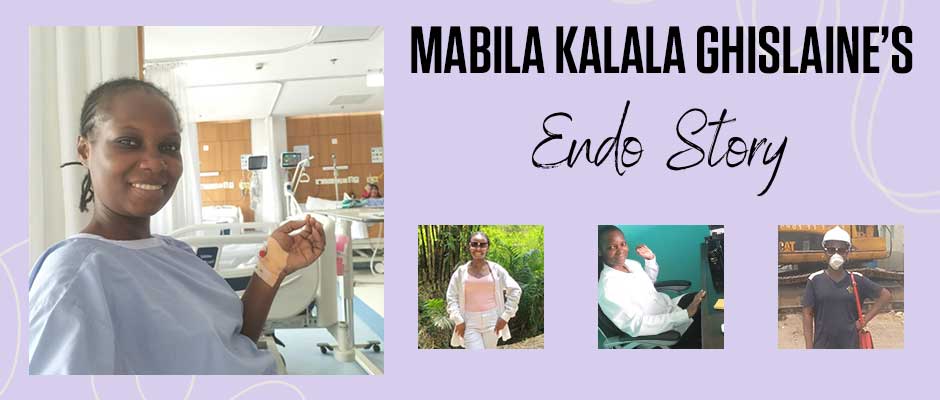
Mabila Kalala Ghislaine’s health situation is simple to explain. The solution, however, is complex.
“There is a name for my pain, but there is so much ignorance about it here,” she said. “I’m struggling. My life is pain.”
The name for her pain is endometriosis, and the ignorance has been torturous.
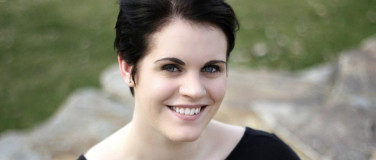
Mabila, 31, is a native of the Democratic Republic of the Congo and lives in Nairobi, Kenya. Her education is in environmental science and management, though she has worked in various fields, including banking and construction. She recently founded Solola Na MWASI (meaning “Talk to a Woman”), a community-based initiative focused on menstrual health education, dignity, and advocacy. Mabila and her team educate adolescents, their parents, and women in underserved communities about menstrual health, chronic menstrual pain, and conditions that are often ignored—most notably, endometriosis.
Mabila’s pain materialized in her pelvic region when she was 12. Her belly often swelled. She missed a lot of school and was in too much pain to play with other kids. Her mother told her that what she felt was normal and that women had to deal with it, so Mabila accepted her plight. She took painkillers throughout her teenage years and into her twenties to get through a day, though they often were ineffective.
“My quality of life was bad. Bad, bad, bad, bad, bad. In my third year of university, I failed my environmental chemistry exam. It was the second day of my period, the pain was overwhelming, and I couldn’t concentrate,” she said. “Later, while working at a bank, I experienced frequent pelvic pain that significantly affected my focus and accuracy. As a result, I made mistakes and was eventually fired.”
Mabila finally saw a gynecologist when she was 23.
“She said I had big ovarian cysts and needed surgery,” Mabila said. “After she removed them, she told me that I had endometriosis.”
The surgeon, however, didn’t know how to treat endometriosis and sent Mabila home—and little has changed since. Mabila’s pain hasn’t subsided in the last eight years, and she hasn’t had another surgery since the cysts were removed. Birth control was the only potentially effective short-term solution one doctor offered her. That was three years ago, and it didn’t help. Mabila said her pain has extended into ovulation, and she can’t move for three or four days during her period. She recently noticed a lump on the left side of her lower abdomen, near the scar from her surgery, and is concerned that it’s the result of more large ovarian cysts.
Mabila is exasperated beyond measure. She’s always been an active person who strives to reach her full potential in every respect, whether at work, in school, or socially, but the pain is dominating her life.
“I don’t even know if they do endometriosis surgery in our country,” Mabila said. “I was reading about it on [EndoFound’s] website, and I also know that they do surgery in Europe, but I don’t have the resources for that.”
She rarely sees a doctor anymore because she’s tired of being dismissed.
“I don’t even want to go there,” she said. “I know what they will say. They will say, ‘You just need to go through this.’ That’s why I don’t want to go. I don’t want to hear it.”
Mabila said the only “remedy” the gynecologist who did her surgery suggested was that she get married and have children. Mabila said a friend of hers with similar pain was told by a doctor that having more sex would help. Mabila also noted that many women face cultural issues surrounding menstruation. For example, she said a local 22-year-old woman she met, who had never had a period, wanted to see a gynecologist to figure out what was wrong. However, her mother wouldn’t let her because the woman was a virgin, and her mother wasn’t going to let a gynecologist touch her daughter’s vagina.
Stories such as those, along with Mabila’s own frustrations, caused her to reflect on her health, personal limitations, and the lack of understanding around menstrual and pelvic pain in professional environments. That motivated her to start Solola Na MWASI. The business enables her to help others while working at a pace that her pain allows.
“A lot of women in Africa are living in ignorance, and many of the doctors are incompetent when it comes to endometriosis,” Mabila said. “I’ve had girls tell me they were bleeding every day for two months, but when they got to a doctor, the treatment was not sufficient. And they don’t want to go to the hospital because they know they won’t get a resolution. They’d prefer to battle it alone. That’s why I’m sharing my story and why I created Solola Na MWASI—to spread information, because I’m finding out that a lot of women are just like me.”
Mabila said endometriosis is not just a medical condition, but a social justice issue, especially in Africa.
“The lack of awareness, delayed diagnosis, stigma, and limited access to care continue to silence millions of girls and women worldwide. I strongly believe that sharing lived experiences is essential to breaking this silence,” she said. “My hope is that my journey can help another young girl recognize that her pain is real and that she deserves care, answers, and compassion.”
To learn more about Solola Na MWASI and to donate to Mabila’s efforts, visit https://sololanamwasi.com.
*Patient stories submitted to EndoFound.org are the patient's views, not necessarily those of the foundation. All testimonials are from real patients, may not reflect the typical patient’s experience, and are not intended to represent or guarantee that anyone will achieve the same or similar results.