

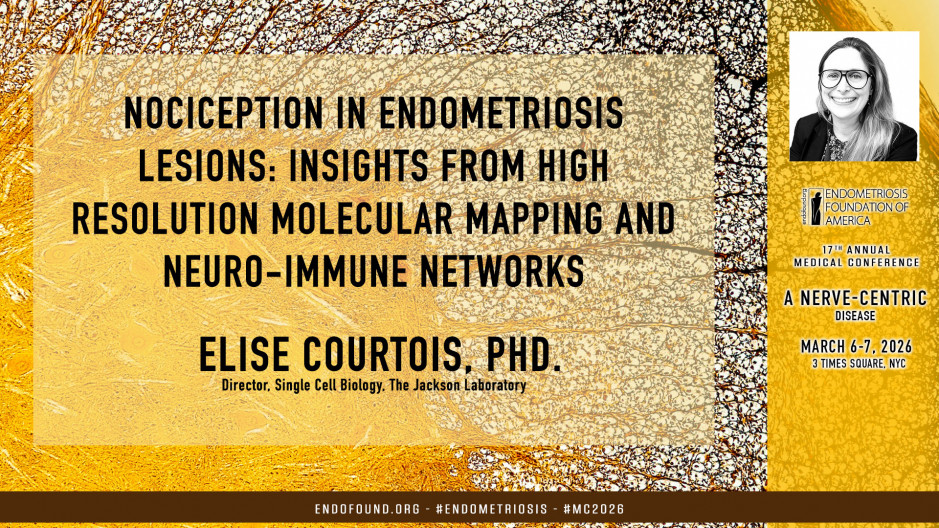
Endometriosis 2026:
A Nerve-centric Disease
Medical Conference - March 6-7, 2026
3 Times Square, New York City
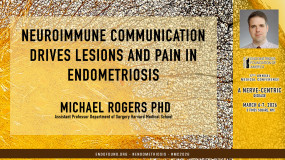
So I don't have to do a lot of introduction on endometriosis and the neuroimmune aspect of endometriosis, but I want to focus on the fact that endometriosis is a very heterogeneous disease. And we've been looking at the makeup of those lesions, really trying to understand what could be the common indifferences across superficial peritoneal lesion or lesions that grow on the ovary like the endometrioma or ovarian lesion. So most of our studies have been focused on sourcing those tissues from patients for our collaboration with UConn Health and Dr. Luciano, and trying to understand how we can apply some of those single cell technologies that we work in my lab to better define the landscape of those lesions. So a few years ago, we did some study to look at the signal cell makeup of those lesions. We performed single cell NISIQ, basically trying to understand and to establish anatolis.
And what we found was that obviously those lesions are extremely complicated. A lot of immune cells are present in those tissues. And we were very interested, as many others have seen in this field, in the subset and the different cell types that compose the macrophage population. So in particular, we saw that some macrophages population share toleurogenic or immunosuppressive transcriptional features across those two type of very different morphologically different lesions. At the same time, we also saw that some of those microphages were expressing pro- neurogenic and also angiogenic factors at the transcriptomic level. And this was very interesting because again, it was a common feature that we find across both superficial and ovarian lesion when we perform these studies. However, when you are using those technologies, it's extremely powerful. You are looking at the whole transcriptome of single cells, but you dissociate those tissues. So you basically lose a lot of this special context and those interaction that define the role and basically the way they're going to be participating in the ecosystem of those lesions.
And in particular, when you compare a tissue that has been dissociated versus a tissue that hasn't been dissociated, you see that you're missing quite a lot of our cells. And in particular, one of them extremely important that our neurons or neural projections were absent from our single cell atlas. This was obviously something that we knew based on previous histological analysis, but also that we saw when we were performing transcriptomic ligand receptor analysis. We also saw that because when we complement our analysis with single cell spatial proteomics, so this is just IMC experiment, we were indeed capable of putting back those cells that we saw in our atlas, but at the same time, we were seeing that a lot of those neuronal projections were actually missing from our atlas. And this is what you see in a picture of a superficial lesion and all the red arrows actually point to one of us neuronal projection that we found in those lesions.
So obviously this is very important because they are an important component of those lesions. They drive pain, but also neuroimmune interactions and are very important component of both type of lesions that we're looking into. So we decided to move into a different type of technology, which basically will help us understand at the single cell resolution, what is the organization of those different cell types, but without going through the step of dissociating tissue, so we'd use what is known in the field as spatial transcriptomics. And in this case, we use one of a technology that allows us to look at the whole transcriptome profile with a very high resolution. So this is a true micron resolution, continuous survey of the tissue. So what we were looking into, and you can ask more questions to Caroline she's here if you want to have more details, but basically what we were happy to say is that across both type of superficial peritoneal lesion or ovarian lesion, we were seeing the same type of organization where epithelial lands are recognized by the expression of epithelial markers like EPCAM here.
Immediately adjacent, we know that we have a layer of fibroblasts that are endometrium-like fibroblasts. They express MME or CD10 protein. And a little bit further away, you have these layer of fibroblasts that are expressing OGN. And this feature was actually constant across both type of lesions. So we decided to define those layers based on the fibroblast and their transcribinomic expression. And because we were not really sure if it was something that we could apply across all the tissues, we use different technologies to confirm our model. So the first one was using the technology of VisiumHD. This is like a continuum whole transcriptomic profile. Here, what you have is in red, the epithelial component. In light blue, you have a CD10 expressing fiberblast that are immediately adjacent. And in purple, you have the fibroblast that are enriching OGN that are layered outside of a CD10 positive layer.
So when we did that also with another technology, this is a different type of complementary approach. It's orthogonal approach. We use xenium assays. So basically it's a probe-based method, but it also gives you a single cell resolution. And we saw the same thing. We saw that those epithelial gland were surrounded by fibroblasts that were expressing high level of MME, and that was seen across both type of lesions. And further away, this OGN reach fibroblast layer. The same thing was seen when we were looking at the proteomic level. And again, we were capable of seeing this organization that was constant across those two type of lesion. So that defined our working model. We have now established this layering where we have a central area that is composed with epithelial gland, and then the immediately adjacent stromal area that we call closed trauma, and the further way that is the first trauma enriched in fibroblast expressing OGN.
So that was great. We thought that it would be also very useful to understand what was the organization and the location of different cell types composing those lesions across those different close and far stroma layers. So we looked at the presence of different type of canonical cell types of the cell, the vascular cells, the immune cells, BT and microphages, but also the fibroblast and the neurons. And what we saw is that ... Whoops.
We could find a high presence of neural beings. So it was our transcript that are assigned to a specific cell type. So in the closed trauma, that was really something that we found across both type of lesions. We also found an interesting enrichment in the myeloid population in this close trauma. And at the same time, we were seeing that there was an increased vascularization of cells that were endothelial lymphatic in the first trauma. Interestingly, we also find that B-cells organized in clusters, and that was very interesting. It was really something that we saw across both type of lesions. So when putting all together those spatial transcriptomics data, the question was how similar this organization is across different type of lesions. So we pulled everything together. Basically, what this heat map shows you is that you have three groups that basically pull together lesions that are coming from both type of lesions, ovarian or peritoneal, and at the same time that they organize when you cluster them in an unbiased manner, and you look at the similarity between the FAR, the close, and the epithelial straumab.
So again, reinforcing that this similarity is something that we could appreciate across both type of lesions. When doing pathway analysis, what we were looking into is beside the organization, what could be a transcriptomic pathway that is common in those specific areas. So what we were seeing is that when you look at which pathways are enriching the closed trauma, what was coming first was really the perception of smell, chemical stimulus, sensory perception, and that was, again, something that we could see across both type of lesions.
So obviously this is important because the neuron presence is an important component, but at the same time, we also know that the neurons are very diverse. The sensory neurons in particular are also not a single cell type. They are extremely heterogeneous. And the previous literature and the previous speakers have really shown that the nociception is an important component in endometriosis because it is involved in the lesion associated pain and inflammation. So what we were looking into is what type of sensory neurons that are enriched in this claustroma we can detect using this transcriptomic approach. So we define different type of sensory neurons, the nociceptors, the proprioceptor and mechanoreceptors. We also saw a little bit of sympathetic neurons, but to be honest, extremely few, and some that we classify as neuroimmune because they were a mix of neuronal markers, but also inflammatory markers. So when we identified those three type of sensory neurons, we wanted to now spatially locate them and really understand how this spatial distribution could help us understand some of those interactions.
So we did the same thing. We actually tried to quantify the presence of those different subtypes of sensory neurons in the different layers that we established in our model. So what you see here is that the nociceptor neurons in dark blue are enriched in this epithelial, close to the epithelial or in the epithelial compartment. They're also important in the closed trauma and a little bit less as we move further with this gland component. At the same time, we also saw that mechanoreceptors were located more further away from the epithelial gland, and that was something constant across those two type of lesions.
So obviously this is something interesting, but we wanted to validate because this is one technology. It was done on a subset of four human peritoneal and four ovarian lesions. So we used the other technology of axinium 5K. And what you see here is that, again, it shows that there is an enrichment in those nociceptor markers really surrounding and even sometime touching the epithelial gland. So extremely interesting because it really shows that there is a spatial organization in those neurons, in those lesions and across both subtype of lesions. So we quantify those and obviously we see an enrichment of the nociceptor transcripts in the closed trauma and we now ask a question. So what is another cell type that could be also spatially located that could help us understand how these nociceptor neurons are working? So as I was mentioning, we did some single cell atlassing of endometriosis lesion previously.
We found a lot of different subtypes of myeloid cells, and in particular macrophage population. You heard already that macrophages are an important component of the immune landscape of lesions. And interestingly, also at the transcriptomic level, we could see that some of us macrophages were expressing molecules that have been shown to promote neurogenesis in vivo. So we went back to our data and we were looking, okay, where are those macrophages in relation to this epi close and fast trauma? And again, we could see that there was an enrichment of those transcripts related to the macrophage subtype in the closed trauma when comparing to other areas in the lesions. So this is interesting, but we can go even further deeper. We can look at subtypes of macrophages. In this case, it was looking at a subtype that we know is important, the activated macrophage subtype that we previously defined.
And what you can see here is that there is an enrichment around those epithelial component that is labeled in orange, and that is something obviously that we can quantify with an enrichment of activated macrophages in the epi and closed stroma across both lesion types.
We further ask the question, so how can they talk together? So this is a ligand receptor analysis that we perform using the VisioMHD platform. Basically, what that shows you is that when you look at how many connections through ligand receptor pairs, we can detect across both the close and the first trauma and comparing ovarian and peritoneal lesion, you can see that there is a much higher amount of connections of potential interactions between macrophages and neurons across different replicates when we look at the close versus everything that is happening in term of potential connection in the first trauma. So again, reinforcing the theory that the spatial location may be driving some specific interaction in the spatial context. So last, we wanted to validate some of those interactions. So what you have here is an in vitro model that we build. We used human in IPS lines, so prepotent cell line, induced peripotent cell lines, that we differentiate into peripheral sensory brain organoids that takes about 90 days.
And then we put them in code culture with fibroblasts and epithelial organoids that are derived from patient derived tissues. So Vatico culture system is maintained for 10 days and within some transcriptomic analysis, but this is what it looks like in vitro. So you have here the brain organoid, and when you put it in co-culture with those epithelial organoids, you don't see the fibroblast because they're below, they start really growing and extending neuronal projection and sometime even touching. So when we perform some transcriptomic analysis of viscoculture system, what we were looking into is how the co-culture of voice three components were actually impacting what we were seeing at the organoid neuronal phenotype. And that was interesting because when we looked at the ratio between sympathetic and sensory neurons, what we could see is that those brain organoids, when culture in the presence of epithelial or fibroblast component, that again, are mimicking the AP and closed trauma that we have in vivo.
We see that there is a shift towards the sensory neuron phenotype in those brain organoids. So again, really reinforcing that there is a cross communication here and that the presence of those cell types may influence what we see and explain what we see in vivo. So we also did some further analysis. We look at the pathways. We were interesting into understanding if there is anything that could help us understand better the communication between those epithelial fibroblasts and organoids in the in vitro culture. And what we saw is that there was an increase of neuroinflammation signaling pathways. Those signaling factors probably are coming from both the epithelial and fibroblast. And when political culture, we see that it actually increases pathway that are related to sensory perception, neuroinflammation in those co-culture systems. So what this study using spatial analysis tells us is that we can define some shared spatial stromal layers relative to epithelial gland across lesions.
We define them as both as close and force trauma, and that we also can define the landscape of a neuron subtype. So in this case, not just sensory, but different type of sensory neurons. We're looking specifically into the spatial organization of a neuron and macrophages, but also how the presence of some of us epithelial and fibroblast cells that are present in those different compartments may be promoting sensory neurogenesis and for inflammatory pathways.
Obviously, I want to quickly have a word here about what we're doing at the state level. Endometriosis we know is chronically underfunded, and I believe you will hear tomorrow or on Sunday Representative Jillian Gilchrist. She's a state representative we've been working with for many years now in Connecticut. And we have built the endometriosis working group, which is a group that basically meets monthly, and I see quite a few people here in the room that are attending this meeting. And what we've been doing in Connecticut is to try to support research. So for that, we have passed several legislature pieces. So we have two laws, a third one that has now been raised and heard on the floor. And basically the idea is, can we help and support research by creating some infrastructure that basically will help researchers like me and many others to understand the disease?
So this is taking the shape as a biorepository that basically is a statewide and state supported biorepository. We have banked above 5,500 biospecimen and we have now started to distribute and we are, I believe, following a path that we want to replicate across our state because that really helps disseminating patient derived biospecimen to promote research. And just want to say that we conduct a lot of QC on those tissues really to make sure that they can be used and provide valuable data. So with that, I want to say thank you. If you have some questions about NDRISE, our program manager is in the room and has a table and obviously to everyone that has contributed, most of the work that I talked about is from Caroline Haney, not Haley, and about the neuron and immune landscape of endometriosis. This is my research team, this is my single cell team, and this is the endoRISE team and all the funding sources.
Thank you.