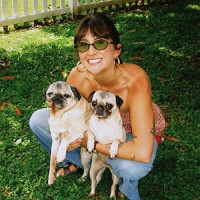


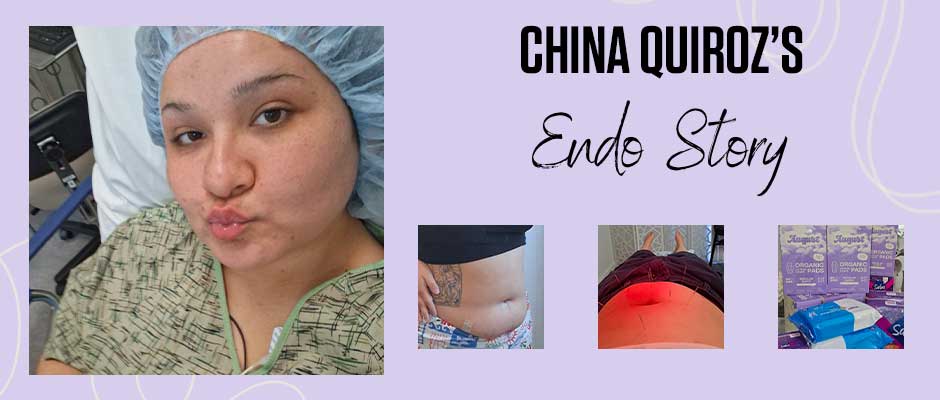
If life had gone as planned for 23-year-old China Quiroz, she’d likely be preparing now for the start of the school year as a new teacher. Instead, the endometriosis that’s affected her since age 11 has altered her path—and she’s ready for the challenge.
While continuing to search for answers to her symptoms, the Southern California resident expects to finish her final semester of college this fall with an associate’s degree in English. She’ll then return to school, this time to earn the credentials she needs to become a medical coder.
“Because of the endometriosis, I had to pivot,” Quiroz said. “For about three years, I worked in an elementary school as a noon aide and health aide, and I thoroughly enjoyed it. That’s why I wanted to become a teacher. But as my illness got worse, it was too hard to work with. As a medical coder, most of my work will be remote.”
Quiroz said that by the age of 16, she’d seen more than a dozen OBGYNs. Her very first one, in middle school, told her that she was experiencing normal period pain and needed to let her body adjust. At 14, when nothing had changed, she did her own research and determined that she likely had endometriosis. She took that information to each new doctor.
“They all had different reactions, and I actually got more bad reactions from female doctors than male ones,” Quiroz said. “They would scoff or giggle and say, ‘No, you’re too young. It’s just a period and you have to get used to it.’ Then they would proceed to try to write me a prescription for opioids or other painkillers, and I’d say, ‘No, that’s not what I’m here for.’”
During her sophomore year, pushing to be heard while getting by on Tylenol and lidocaine patches, Quiroz found an OBGYN who listened and agreed to do surgery. The surgeon found some endometriosis and ablated it. She also diagnosed Quiroz with polycystic ovary syndrome and adenomyosis. While most endometriosis specialists do not recommend ablation, it provided Quiroz with a bit of relief until the end of her junior year. But when the pain returned, as it often does after ablation, it was worse than before.
“I was severely cramping, but on top of that, I had long, unpredictable periods, including one that lasted for three months,” Quiroz said. “I also started to have nerve pain in my legs, as well as all the way up to my shoulders.”
Quiroz was forced to complete her senior year at home.
“I pushed through as long as I could, until my body couldn’t get through six class periods anymore from all the pain and fatigue.”
She said she tried every remedy imaginable, including oral birth control, IUDs, diet changes, pelvic floor therapy, red light therapy, acupuncture, cupping, and numerous pain medications.
“Not even morphine worked,” she said.
She had her second surgery with the same surgeon when she was 19, though she said this one was excision, considered the gold standard by most specialists. It’s unusual for a surgeon to do ablation one surgery and excision the next.
“I think with the first surgery, she was just trying to figure out what was wrong,” Quiroz said. “Maybe she’d gotten more educated in between the two surgeries.”
But not educated enough.
Quiroz said the surgeon removed endometriosis from her pelvic region the second time, including some that connected her uterus to one of her ovaries. However, Quiroz said some of the disease was left on her ovary because the surgeon didn’t trust her own skills to remove it without damaging the ovary. Quiroz felt good for about a year after that before the pain returned—again, worse than before.
After taking a break from surgeries to get married and focus on her education, Quiroz had her third surgery this past December with the same surgeon. The surgeon excised more endometriosis but left the ovary alone again. Quiroz hasn’t felt any respite since then.
“I feel like the older I get, the more aggressive it gets,” she said. “It’s harder to find relief in things that I used to be able to find relief in.”
Quiroz said she’s been to the emergency room “probably 25 times” throughout this journey, yet she refuses to give up. She recently found a new surgeon with more specialized skills, and she will meet with her later this month to determine a course of action. Until then, Quiroz plans to finish her degree, then pursue the next one.
While she’s accepted that this chronic illness will prevent her from teaching in a classroom, she hopes sharing her story educates someone suffering from similar symptoms.
“A lot of my community with this comes from TikTok and other social media platforms, and I run across girls who have just found out they have it or still don’t know what’s wrong and are in a lot of pain,” Quiroz said. “I just comment or DM that if they need something, I’m here. I really want to raise awareness because it’s genuinely the most painful thing ever, and it’s touched every portion of my life.”
Quiroz is grateful to have the support of her husband and parents, who have sacrificed a lot to help her. They’ve also helped her keep a positive attitude, even through the most trying times. She said that while that can be difficult, it can help mentally and emotionally.
“Endometriosis can feel like the end, but it can also be the beginning of a new part of yourself,” she said. “Help others who are going through this when you can, and know that you will make it through.”
*Patient stories submitted to EndoFound.org are the patient's views, not necessarily those of the foundation. All testimonials are from real patients, may not reflect the typical patient’s experience, and are not intended to represent or guarantee that anyone will achieve the same or similar results.