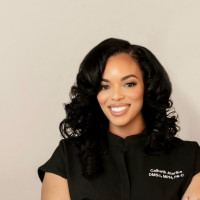


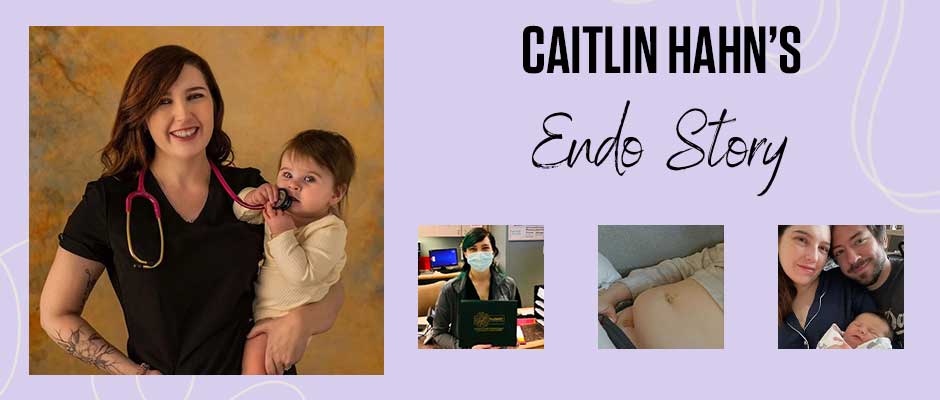
Compared to many other endometriosis patients, Caitlin Hahn’s story of living with the disease for the past two decades has been a bit different.
She had period pain as a teenager, but nothing that disrupted her life significantly. While on birth control in her 20s, she went to school and worked full-time without too many issues. She gave birth to her daughter three years ago at age 30, conceiving just two months after going off birth control. All of this happened in the years before her endometriosis surgery in June, when she was diagnosed as being between stages three and four.
“I know how lucky I am to have a three-year-old daughter and that my symptoms were well-controlled for so long,” Hahn said. “But, thankfully, as my symptoms got worse, the surgeons I worked with in my job as a recovery room nurse essentially bullied me into being seen and evaluated and getting my surgery.”
Hahn said growing up with three brothers helped her develop an attitude in high school of “toughing through it and gritting my teeth” anytime she felt pain with her period. “The only time I remember having to leave school early because of my period was one day when we had to run a mile in physical education class,” she said. “The combination of running and having really bad cramps caused me to throw up.”
Hahn’s mother, who also had endometriosis with symptoms that began in her teen years, advised her daughter to take two Aleve when her cramps became unmanageable.
“She never really said much about having endometriosis other than that she also had a really bad period,” Hahn said. “Taking the two Aleve helped, so I never questioned it further.”
Hahn was on birth control through most of her 20s while she worked and went to nursing school. It kept most of her symptoms at bay, though she did occasionally end up in the emergency room for abdominal pain.
“They’d always just say it was a cyst,” Hahn recalled. “Around 2019, when an ultrasound showed one of the cysts was an endometrioma, I asked if that meant that I had endometriosis. They said, ‘No, it doesn’t.’ I later learned they were wrong, and I don’t think I had a true understanding of how bad and prevalent endometriosis was until a few years ago when people [in the hospital where I worked] were coming in to get treated for it all the time. It felt like we were doing four or five excision surgeries almost every day.”
At the same time, Hahn’s pain level was increasing while her periods were getting heavier. She powered through work, though she often curled in a ball with a heating pad when she got home. She was also off birth control again, trying to have another child, but still hadn’t conceived after more than a year.
“Historically, nurses are bad patients,” Hahn laughed. “I had put it all together that I likely had endometriosis, but I just wasn’t following up. Not until they bullied me into that appointment.”
That appointment was in the summer of 2025 with an endometriosis specialist, and Hahn was supposed to have surgery in November, but she postponed it after starting a new job two weeks earlier. It was rescheduled for February, but she had to postpone it again to attend to a medical issue for her daughter. She finally had the surgery in June.
“There was so much endometriosis,” Hahn said. “It was all over my pelvis, in my rectovaginal area, on my ovaries, on my bladder. It was everywhere.”
Hahn said her first period post-surgery was painful, which she expected. Her second one, in August, was what she’d hoped for.
“The difference between the two was astounding,” Hahn said. “The second time around, the bleeding was light and the cramping was minimal. I didn’t have to bust out a heating pad. I didn’t even have to take Aleve.”
She said she couldn’t be happier with how the surgery went, but she still has one major goal.
“I hope to get pregnant within six months. That’s when my surgeon told me the highest rate for conception is after surgery,” she said. “If nothing happens, I have a plan with my doctors to explore what else might be happening. Was it just endometriosis that prevented me from getting pregnant again, or could there be something else going on?”
Hahn admits she should have done more to help herself early on, and she wants other women with symptoms to stop putting them off and avoid her mistakes. She also wants those who have endometriosis to speak up about it being a debilitating disease and not just a bad period, as she is doing now.
“I’ve been very vocal about it, and I’ll continue to be. I want to give people hope, and unless we talk about it, they won’t know how common it is,” she said. “They need that support. They need to know all of the resources that are available. And they need to know that they can’t be afraid to talk about what they’re feeling and advocate for themselves.”
*Patient stories submitted to EndoFound.org are the patient's views, not necessarily those of the foundation. All testimonials are from real patients, may not reflect the typical patient’s experience, and are not intended to represent or guarantee that anyone will achieve the same or similar results.