

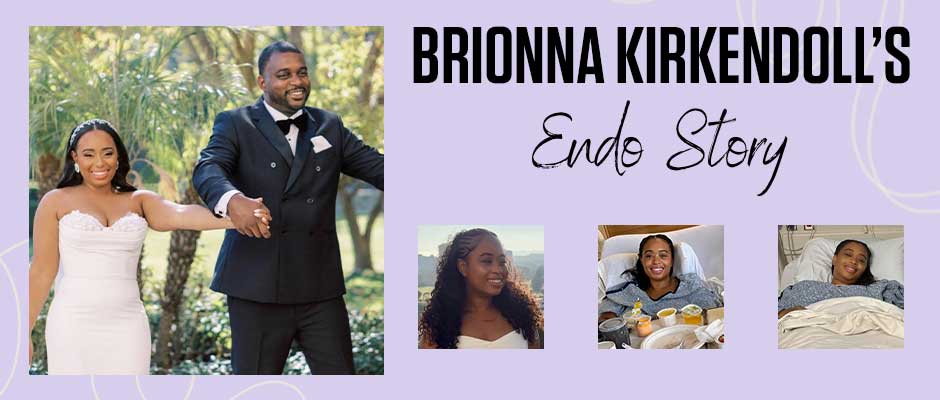
Brionna Kirkendoll felt severe pelvic pain when she had her first period at 14. Doctors initially told her it was gas. When the pain didn’t subside, they wasted no time putting her on birth control—and kept her on it for nearly 13 consecutive years.
“I’ve had every kind of birth control, from the patch to different pills to the Depo-Provera shot, and it all worked,” Kirkendoll said. “I never had a period while I was taking birth control, as I was on a continuous method.”
Kirkendoll, 34, started on Depo-Provera when she was about 17. Ten years later, a new doctor told her that she should not have been on the shot for that long (it can cause other health risks, including bone loss) and should come off it immediately.
“I was never informed prior that I was on it too long. I stayed off all birth control at that point to let my body clear out, but I didn’t really know what to expect,” Kirkendoll said.
What she got was quite a shock.
While the various birth control methods allowed her to live a symptom-free life as a teenager and well into her 20s, they masked the endometriosis that she and her doctors didn’t know she had, which never stopped growing.
“As soon as I stopped taking the shot, I had a lot of pelvic pain and severe cramping, and my bowel movements were beyond painful,” Kirkendoll said.
She managed the symptoms the best she could for seven years, until December 2024, when she started vomiting during her cycle. Kirkendoll and her fiancé, Raymond (now her husband), knew they needed to find a solution but didn’t know where to turn.
“Doctors kept telling me that nothing was wrong,” she said. “I’d had a pelvic ultrasound, all kinds of other tests, and several different opinions. They all said nothing was wrong, maybe just a cyst on my ovary.”
In January 2025, Kirkendoll began researching her symptoms in an attempt to diagnose herself. That search led her to EndoFound’s website, where she learned about endometriosis. It was the first time she truly understood the condition—and her symptoms matched.
“That’s when I knew I had endometriosis,” Kirkendoll said. “Something was different about me compared to my friends and colleagues. I was dying in pain while they weren’t. I also knew when I was ovulating. My friends said, ‘How do you know that? We have no clue when we’re ovulating.’ I said, ‘I feel pain during the entire process. Maybe I’m crazy, but I can feel it.’”
She wasn’t crazy.
Kirkendoll went to a new OBGYN in Beverly Hills, who did another pelvic ultrasound and said she still didn’t see anything. When Kirkendoll insisted that she had endometriosis, the doctor said the only way to diagnose it was through surgery.
“I said, ‘That’s fine. I work at one of the best hospitals in Los Angeles. I’ll take that risk,’” said Kirkendoll, a medical social worker at Cedars-Sinai Medical Center in Los Angeles. “I’d read about how some people go through the surgery and they don’t find anything, but I told myself, ‘Nope, don’t think like that. They will find the endometriosis during surgery.”
She saw a Cedars-Sinai minimally invasive gynecologic surgeon, who scheduled her surgery for April. In the meantime, the genecologist did an MRI to give herself a roadmap of what to expect during surgery. When the results came back in March, the gynecologist said she could see that endometriosis was everywhere, including on both of Kirkendoll’s ovaries, her bowel, and her bladder. Several of her organs also appeared to be stuck together.
“We had to cancel my April surgery date because I needed to see a colorectal surgeon and have a colonoscopy to make sure there was no endometriosis inside the bowel. I was devastated because I knew this was going to push my surgery date back,” Kirkendoll said. “Fortunately, during the colonoscopy, they found no endometriosis inside. They just found some polyps and were able to remove them.”
Kirkendoll’s surgery was rescheduled for May 30. Her endometriosis was in stage IV.
“It was only supposed to be a few hours. It ended up being seven,” she said. “They removed the endometriosis from my bladder and ovaries, and they removed my appendix, which was covered in it. They also had to take off five inches of my lower sigmoid [the part of the large intestine that connects the rectum].”
Due to that bowel resection, Kirkendoll remained in the hospital for a week following surgery. She returned to work at the end of July.
“I’m a little over six months post-op, and I feel good. Better than before,” Kirkendoll. “I was on birth control for the past six months to help me heal. I just came off it, had my first menstrual cycle, and felt a little bit of pain, but I didn’t need any medication for it. I used to take pain pills around the clock, but this was the first cycle in my life in which I didn’t have to, which I thought was a miracle.
“I was bracing myself because I know everybody’s story after surgery is different. I’ve heard stories where it worked for some and not for others,” she continued. “It’s validating that I had endometriosis and that they say they got it all out, but it’s also emotional because I don’t really know what’s next.”
Kirkendoll and Raymond married in November 2025. They hope to have children and are seeing a fertility specialist in 2026 to help with guidance. Fortunately, Kirkendoll’s surgeon was able to preserve all of her reproductive organs.
“Before surgery, they told me I might need to have a fallopian tube removed,” she said. “But during the procedure, they performed a chromopertubation—a dye test used to check for blockages—and found that the tube wasn’t blocked. When I woke up, they told me both tubes were fine, which was such a relief.”
While the newlyweds enter this new phase of their life together, Kirkendoll is also dedicating time to publicly sharing her story. She wants those with symptoms to understand the pros and cons of birth control, to know what endometriosis is, and to trust what they are feeling.
“I know now that birth control was kind of a bandage. It worked for me, but if I hadn’t taken it, maybe they would have caught the endometriosis when it was in stage I and not stage IV,” she said. “My biggest advice is to trust your body and your voice. You deserve to be heard and to receive proper and compassionate care. Continue to advocate for yourself, even when it feels exhausting. And seek support from people who truly understand what you’re going through.”
*Patient stories submitted to EndoFound.org are the patient's views, not necessarily those of the foundation. All testimonials are from real patients, may not reflect the typical patient’s experience, and are not intended to represent or guarantee that anyone will achieve the same or similar results.