

Endometriosis 2026:
A Nerve-centric Disease
Medical Conference - March 6-7, 2026
3 Times Square, New York City
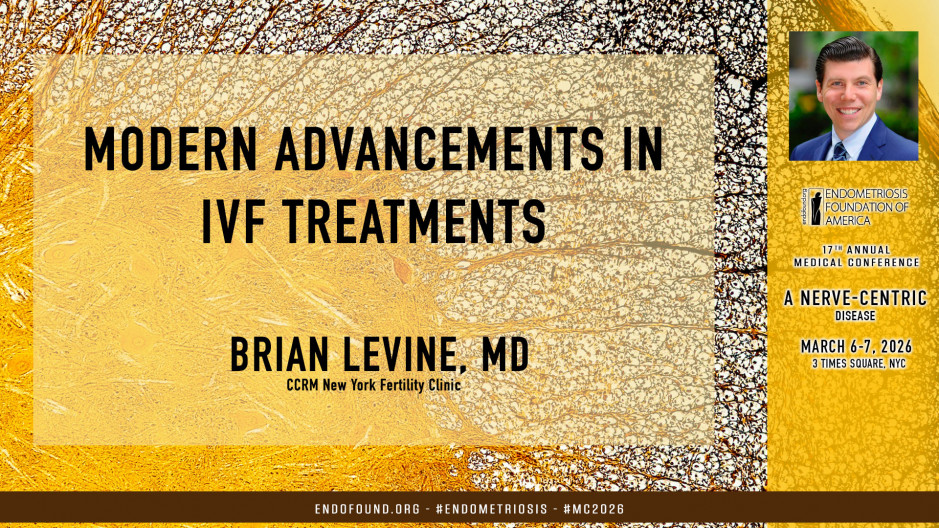
Thank you. Can you guys hear me? Is this the microphone on? Great. Thank you for having me. I know that I have actually the toughest role of any speaker today because I'm holding you from the end of this conference. So I promise to end on a high note and to excite you guys and to keep you all awake and off your phones. Okay. First and foremost, thank you all for being here today. Thank you for enduring an amazing conference over the last two days and talking about a topic that's near and dear to my heart. So what we're going to talk about today are some modern advances in IVF. We're going to really go through kind of what's working, what's not working and what's exciting. Most importantly is we're going to try to look at this from a patient's perspective, because at the end of the day, what I do for a living, what most of you guys do for a living is take care of patients.
So talking about molecules and talking about approaches is great for academics. But at the end of the day, patients want to know, what can you do to help me achieve my goal, which is to have a baby. First and foremost, this is not a Photoshopped picture of me. It's just 10 years ago.
Second, what we're going to talk about today is increased prevalence of infertility. So let's do a little audience engagement. Raise your hands if you think one in 10 women worldwide suffer from infertility. One in 10. Okay. We have a quiet audience. Let's try one in five. Okay. We have one hand up. The answer is somewhere in between. So it's one in six we think suffer from infertility worldwide, so it's an incredibly prevalent condition. What most people don't talk about is that the three most common reasons that people do IVF or in vitro fertilization is number one, advanced maternal age. Number two, male factor infertility, right? The other 50% of the ingredients of making a baby. And number three is endometriosis. We know that number three is becoming much more prevalent because finally gynecologists are starting to talk to their patients about pelvic pain and about their aspirations of having a family.
We also know that as a result of people delaying their family building timelines and their childbearing years, that directly impacts both IVF success rates and people overall seeking treatment. And lastly, I think it's appropriate that we all should demand from our doctor's personalized care. The fact that we just have a general protocol or a general approach for every patient really doesn't cut it anymore, especially when patients can go into ChatGPT and out research us before we even walk in the room.
So here's a quick story of the history of IVF. I will not put you to sleep because the room is already warm and the day has been long, but I will say to you that I'm 46 and IVF has been around for 47 years. It is important to know that over these last 47 years, we have seen a lot of advancements. No longer is the trend now of whatever grows in the lab we just put back in the patient. Now there's a growing trend, thankfully, where we can select the single best embryo for a patient with or without genetic testing. But more importantly, and I think what's most exciting is that we've seen that AI now is actually really playing a great role in both the management of clinics, the management of patients, and more importantly, the management of embryos.
So we know that there are some really important innovations that are occurring within the world of IVF. One of the most important is actually cryopreservation, and I think it's pretty cool. That was my terrible joke that no one laughed at. So basically, cryopreservation means the freezing of eggs, embryos, and sperm. This is important to discuss because quite often patients will come to us preoperatively before having surgery for endometriosis, and we might offer them the ability to freeze eggs and protect their fertility before going through a surgery that either could be destructive or that could be detrimental to their overall ovarian reserve. There's an argument though that maybe they should have their surgery first before having their egg freezing because the quality of the eggs that you'll get after surgery would be improved. With that said, the fact that we can freeze eggs, embryos, and sperm with great efficiency and efficacy is important because that means that we can have a patient go through staged procedures.
She comes in today desiring a child in the future. We freeze her eggs, she treats her endometriosis, she finds prince charming, we thaw those eggs and make embryos, and then we do her transfer when her body is best ready to receive that embryo. That's actually what cryopreservation really should be talking about, and that's what's amazing about it. Time lapse. So I come from a world of where we take an embryo and as soon as we see it that it looks mature, we take a piece of it that's called a biopsy and we genetically test it. Truth be told, I think we're getting to a place now where we don't need to do such an invasive testing to embryos. Where now we're actually able to take a look at the morphokinetics or actually how the embryo is dividing and changing under the microscope and use time-lapse photography to actually say, is this normal or abnormal and potentially select the best embryo for transfer without having to do an invasive technique.
That's where AI is starting to play. So we're seeing that AI is actually creeping into our clinic in many places. The most commonplace that AI is creeping into everyone's clinic is in billing and no one talks about that where actually all the insurance companies are using AI to actually make sure that you're getting the proper reimbursements for the doctors and that patients are being charged appropriately and that they're using the benefits the best way. But benefit talking is boring, so let's talk about the lab. We know that AI is being used to pick the best eggs to fertilize, the best sperm to select, the best embryos to transfer. We also are using AI to help us make clinical decisions of when should you trigger the patient for retrieval? When should you transfer this into the best lining? And it's really guiding our decision trees. I give a lecture about AI frequently around the world, and I always have this opening slide saying that I truly believe that AI will not replace doctors, and I firmly believe that.
But doctors who don't embrace AI will be replaced, and that's just fact. And so we need to understand that this is actually the future of computing. We used to call it machine learning, now we call it AI, but it is part and parcel of what we do every day. Pre-implantation genetic testing, as I said before, that's taking a biopsy of an embryo. There's multiple flavors and letters that we use. PGTA is for aneuploidy, so that's actually combating the most common cause of infertility, which would be age-associated infertility, helping us pick out chromosomally the right embryo or the wrong embryo to discard. PGTM is looking for a disease, so specifically ... I think we're getting an echo up here. So specifically, if the two individuals or the two parents actually share a common gene in their carrier screening and it might have a recessive condition, we can actually make sure that 25% of their children are not going to suffer with this disease.
Or if they actually have a cancer gene, like the breast cancer gene or other genes that are detrimental in life, we actually can screen the embryos to make sure that 50% of their embryos won't be affected. There's something called PGT-SR. So those are for structural rearrangements, and those are for patients, for example, who have a translocation or an accent that occurred when they were inside their own mothers during development. And then the last one, which I think is probably the most controversial, which I do not subscribe to is something called PGTP. And for this one, this is actually looking for traits that might be a little more subtle. So I'm sure you've seen the news or the subway advertisements in New York City helping you to select potentially for height or IQ or eye color or things like that. But I treat infertility and not just wishes.
And so I think that I stay away from the PGTP world, but it is out there. Lastly, there is this whole world of endometrial receptivity assays or ERAs. Again, this is actually a highly debated area, but more importantly is to understand that you can take a sample of the lining of the uterus and help you understand the archetype of the tissue that's there to help you best time the delivery of that embryo to help improve the success rates. There's these non-invasive techniques, and this I find to be the most exciting stuff that's out there, because believe it or not, people have been reproducing for longer than 47 years. And so before IVF existed, people got pregnant from non-invasive techniques. So let's talk about what we're doing in the lab that's non-invasive. So some really cool stuff is we're actually in my lab looking at spent culture media.
So this is when you grow an embryo within the media, looking at the proteins that are actually going to be excreted and surrounding that actual embryo. We're going to take a look at those to look at the molecular signatures to see if we can pick a better embryo because of that. We have really cool techniques that for those patients who can't go through 10 to 12 days of stimulation, or those who do go through stimulation have a high degree of immaturity, we can actually grow those eggs in the lab overnight. That's called in vitro maturation, which is super exciting. And then again, as I alluded before, receptivity testing to figure out when is the right time and right place to put back that embryo. There's other things that are happening in our field as well, things like PRP or platelet-rich plasma, which of course we know our orthopedics colleagues have been doing for years to help with injuries.
There's some exciting research, although I don't think it's ready for prime time of people doing PRP within the ovary or within the uterus. And there's also new testing of the vaginal microbiome, as well as the endometrial microbiome to take a look at the bacterial milieu that's there within that environment, potentially to optimize the patient for getting pregnant.
Of course, turning innovation into tailored protocols is always the holy grail. So you take some of these advances, you find a bunch of patients for your clinical trial, and then you actually test your hypotheses using the scientific method. And what we're finding, at least in our network of 17 clinics across America, is actually we're able to make a difference in some of these. Specifically looking at the spent media, I think is the most exciting thing we're doing right now, but also looking at the molecular signatures within the vaginal microbiome and the endometrial microbiome to figure out who's actually ready for an embryo transfer. Just for you guys to understand why that's important. Embryos are precious and patients work really hard to make them, and so do the embryologists in my lab as well. 10 to 12 days of shots, five visits to the doctor, a minor surgical procedure to have them extracted, and then seven days in the lab where a bunch of really cool, smart people are doing their best to make that embryo grow.
The last thing you want to do is put that embryo back in the wrong place at the wrong time with the wrong environment. So actually, to me, that's probably one of the most exciting things in our field, and I think that's going to totally change how we actually can offer precision medicine to patients.
I'm going to bore you with this, so I'm going to skip over most of it. My slides will be available later. This is just the network of clinics that I work with. Most importantly, what's really cool about our network is actually we're directly vertically integrated with our genetics lab. So our genetics lab is part and parcel of our IVF lab. So our patients are actually getting the benefit of genetic testing of both spent media and invasive testing of embryos being done all in one centralized location where then I can actually give patients reports about their specific embryos, knowing that we've controlled for as many confounders and variables as possible.
Again, we are openly enrolling patients all of the time into our studies. So if there is a study that you see on our website that intrigues you, please let us know and we're happy to enroll you if we're one of your test sites. And then of course, this is what matters most to me, which is expanding access to IVF. Today, most people don't realize that their employers offer benefits. And if you live in the great state of New York and your employer has a hundred employees or more, you have to have a fertility benefit by state law. That benefit is actually loosely defined. So it could be just for fertility diagnostics, it could be for fertility treatments, and it could be as much as getting multiple rounds of IVF depending where you work. It's also important to understand that there's multiple organizations out there that offer granting for patients to go through IVF.
So if it is price prohibitive for someone, there are opportunities that are out there. And I think what the future of affordability looks like is expanding insurance mandates, broader employer fertility benefits, and AI supported treatments so that we can actually be much more precise and hopefully lower the cost of IVF in general. Fun fact, IVF has cost about 25 to $30,000 since 1984. If you were to actually extrapolate that from 1984 to today's dollars, that would be approximately 67,500. So I would argue that IVF is actually getting cheaper as inflation keeps going up, but that doesn't really work when you're talking to a patient to say it's $25,000. It still just sucks. But regardless, I would say that IVF has not increased in price. In fact, it has actually stayed pretty constant over the last 40 years.
Here's a picture of the mandated coverage building, and I always remind patients to look at this map because if you work in one of these states or live in one of these states, you might have benefits waiting for you, which means you should seek treatment sooner than later. Ethical considerations, of course, we should always talk about what happens with the genetic testing and the fear around designer babies. This is what makes the news. This is what makes for subway advertisements, as we saw in New York in the fall. But I think that also patients should understand that genetic testing of embryos doesn't test for everything. We're looking at five to eight cells of a multiple cellular structure. There's close to a thousand cells that we're going to see at some point in this embryo in the earliest phase, and we're looking at five to eight.
Totally possible to have sampling error, totally possible that those five to eight cells are not representative of the entire cellular structure of what you're looking at. They're just giving us a hint of what we're looking at. That's also important to recognize that if you're looking for a six-foot banker, blue eyes or whatever that song is, you may not get that from the embryo that you think you have because it may not be representative of the biopsy that you're taking. Also, I think that what's really important to understand in this political environment that we're in right now, we are in the most IVF-friendly administration that we've ever seen. I actually sit on the White House committee for IVF. I'm one of the four doctors in America that does that. With that said, there is always a conversation that sits behind us on personhood, and personhood is actually assigning an embryo that is saying it actually could be an individual.
There are certain states in America that have personhood bills today, and we should just recognize that if that happens and personhood becomes a thing, it'd be very difficult for us to figure out what to do with patients' extra embryos because discarding them could be viewed as either manslaughter or murder according to certain state laws. So personhood is actually a very real consideration to think about. Looking ahead for emerging technologies, I think the most exciting thing is actually AI today, looking at assessing the patient. Unfortunately or fortunately, part of being an IVF doctor is breaking bad news, and one of the worst things I have to say to a patient is, "I think you did great and we did great, but next time we could do better." And the patient says, "Why is this bad news?" And I said, "Well, we have to pick a new protocol, and I wish the protocol that I'm going to pick is the one that I started with.
" But of course, algorithmic approaches for every patient doesn't work and some patients don't get captured within that. So I think that in the future, as AI helps us pick personalized medicine to pick the right protocol for the right patient so that they can do fewer cycles, will be a better use of dollars. That will ultimately lead to improving outcomes, and more importantly is expanding applications and opportunities. I think that we're going to keep advancing IVF as far as we can. I can tell you that I'm a fearless continued advocate for patients having increased awareness and hoping that patients seek treatment early, having actually really smart doctors like Dr. Seshkin who says to a patient, not, are you going to freeze your eggs? More importantly, when did you freeze your eggs or when are you freezing your eggs is really important when you're talking to patients, and most importantly is collaboration and understanding that it's a continuum of care and I'm just one small part of a patient's journey as they lead their path from where they're coming as a patient to ultimately being a parent.