

Endometriosis 2026:
A Nerve-centric Disease
Medical Conference - March 6-7, 2026
3 Times Square, New York City
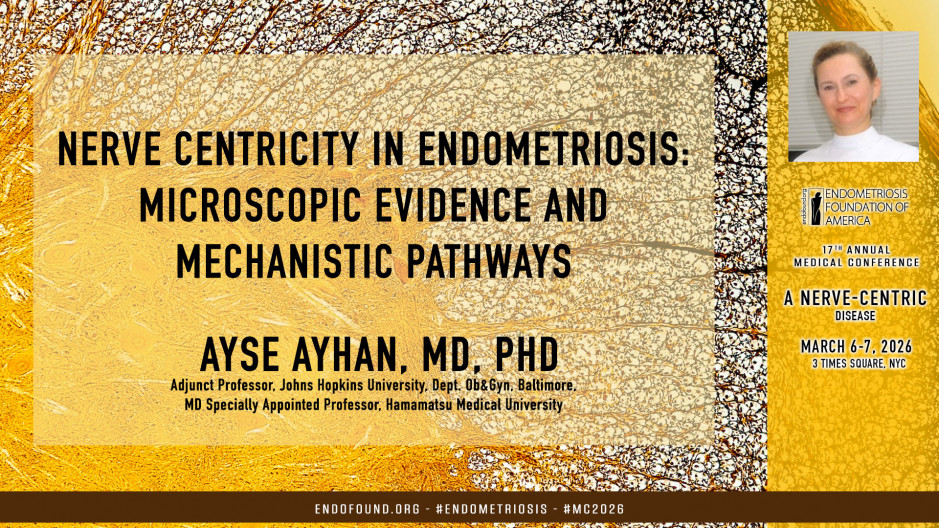
I hope that this will be last speech, but I hope you still have some energy to hear my speech. I would like to discuss nerve sensory theory in endometriosis, but not from the symptom perspective, but from a histopathological perspective. This is about what we actually see under the microscope and how those observations reshape our understanding of pain in the disease. Before I begin, I would like to express my gratitude to Dr. Setskin and Dr. Martin and the end of our team. It's a true privilege to be here. For decades, endometriosis was described simply as ectopic or aberrant endometrial. And the pain was attributed mainly to prostaglandins, inflammation, or mechanical mass effect. However, several clinical observations challenge this model. For example, the pain severity does not correlate with lesion size or the deep lesions are disproportionately painful. Furthermore, inflammation and fibrosis fail to fully explain the hyperalgesia.
These symptoms persist or recur despite surgery or hormonal suppression. Based on those discrepancies, we think that there is something structural which must be over. Historically, attention focused on fibrosis, scar-like appearance of the lesions. And this also creates a contradiction. If these lesions were merely scar tissue, they should not generate hyperalgesia because scar tissue is typically poorly innervated. Yet, despite the highly fibrotic nature of the lesion, most of the lesions have severe pain phenotypes. Therefore, fibrosis alone cannot explain sensitization. Increasingly, pathology findings suggest that endometriosis is not only a hormonal or murally and inflammatory disease. The conceptual turning point occurred between 2002 and 2006, where experimental studies started by Tokushik and colleagues demonstrated increased nerve fibers, including sensory C fibers. That was the first time where structural innervation of lesions were documented. Even earlier, Tokushiki had shown small nerve fibers in endometritic lesions in the ertopic endometrium of endometriosis patients and compared with the non-endometriotic patients.
And then subsequently, he show protein gene product 9.5 or neurofibromine which demonstrate myonated fibers or substance B or calcitonin gene-related peptides, CGRP, acetylcholine, and thyrosine hydrolase within the endometriotic lesions of endometriosis patients. Importantly, these neural changes occurred along with the increase in NGF receptor increase within the lesions. Similar findings were later reproduced in experimental models in baboons by Donus and later in humans, again by Dunas, peritoneal lesions by acid in 2019 and biosomal in 2022 within rectosigmoid nodules. Again, these findings support the idea that endometriosis should be a disease of aberrant nerve endometriotic tissue interaction. Next major step occurred in 2009 when Dr. Sylvia Meshner and colleagues showed that nerve density correlates with pain and also identified that small fiber innervation was identified even in peritoneal biopsies. At this point, the concept of neuroangiogenesis emerged and it suggested that inflammation and neural growth are biologically linked.
From that moment, innervation could be no longer considered incidental. What do we see under the microscope? Under the microscope, we consistently observe dense peripheral nerve fibers within and around the lesions. This is a deep infiltrating lesion of Dr. Setskin. Normally peripheral nerve fibers may not be identified by H&E solely. However, we use immunostechemistry against nerve specific tissues to clarify like synaptophizing a hundred PGF-9.5 or MAP2. Furthermore, this phenomenon is not restricted to the one subtype of endometriosis. Other than deep nodules like this case, we further can compare non-endometriotic area nerve concentration to the endometriosis nerve concentration and see whether there is an overlap between different antibodies. So this is a peritoneal endometriosis case of Dr. Sekin. And we do see the similar pattern in peritoneal endometriosis. Let's see what happen when we immunostain this peritoneal endometriosis when evaluated by S100, which is a calcium binding protein marker used in pathology to identify cells of neural crest origin, particularly it stains Schwan cells neurons, but also melanocytes.
So some people do not consider specific. So we generally combine with other antibodies. For example, PGP, which is an antibody of protein gene product 9.5 showing nerve sheaths. So you can see that non-endometriosis areas show very few nerves. However, two different areas of endometriosis show is 100 positive and PGP 9.5 positive areas. MAP2 is a microtubule associated protein. It's a neuronal cytoskeletal protein involved in microtubule association and microtubule stabilization. As you know, synaptrophizin is a protein found in precinct vesicles of neurons and neuroendocrine cells. So here again, the same areas demonstrated in non-endo area, we have very few neurofibers compared to endometriotic part of the peritoneal disease. Together using several markers, we can confirm true neural structures within lesions, and we also can see the overlapping of the positive cells within the lesions. So importantly, these nerves are not randomly scattered. They are structurally integrated into the lesions because they have close associations with glands, stroma, and fibrosis.
So they are also embedded within the fibrotic nodules, particularly in deep endometriosis. And this suggests organization rather than an incidental growth. In this context, fibrosis may function as a scarfold rather than simply a scar tissue. Furthermore, we can verify that these neural structures are not passively interrupt because neurotropines such as nerve growth factor and its receptors are upregulated. CGRP calcimin gene-related protein is upregulated substance P, which are neurotransmitters and modulator in the central and peripheral nerval system are upregulated and expressed. Furthermore, GDNF glial-derived neurotropic factor perceptin and neurotropine three and four for neuronal guidance molecules like semophorin-3A or three SLET-2 and A receptors are also expressed. These lesions in some papers were shown to be inhibited by RAMP1, which is receptor activity modifying protein or dopamine agonists. Serum increase in brain-derived neurotropic factor involvement associated with lesions all demonstrate that the evidence that supports ongoing nerve sprouting within the lesions confirming the dynamic remodeling.
As discussed earlier in today, this meeting, this process is not solely neural or immun neural interaction. It's a hormone sense. It should be a hormone sensitive neuroinflammation because we can see macrophage clusters in and around the nerves which are a surgeon receptor positive that shows local immune neural dialogue. At this point, I would like to present some thoracic endometriosis cases from Dr. Secon collection where the patients had simultaneous drug operations. This is a diaphragmatic endometriosis, H&E staining surgical material, and you can see a nerve, a rather large diameter nerve infiltrated by endometrial stromal cells, which are positive macrophage markers, CD68, and which are positive for extragene receptor. So this demonstrates and confirm that it's not a simple inflammation. It's a hormone sensitive neuroinflammation and hormonal modulation of nerve immune interaction within the microenvironment. And this also shows that endometrial stroma cells, there's no epithelial cells, but endometrial trauma cells migrate a single cells or clusters not only along the peritoneal tissue, but also within and around the nerves, which is accompanied by macrophages seen here.
This is another case from Dr. Sekin's collection. It's rather easy here to see the peripheral nerve clusters, the increase by H&E.
And this is the area that I have stained for further examination. Again, we could demonstrate that CD10 positive cells are clustered within or around the peripheral nerves, and they are positive for a surgeon receptor. Furthermore, macrophages, CD68 positive macrophages accompany to the cells or they express the same marker along with CD8 cytotoxic T cells and natural killer cells as exemplified by CD8 positivity. Integrating these observations, a loop is conceptualized. Estrogen influence immune cells. Immune cells release cytokines and cytokines promote neurogenesis, nerves release neuropeptides and those neuropeptides contribute to fibrosis where fibrosis stabilize and sensitize neural network. Then this becomes this self-sustaining cycle, a vicious cycle. If nerves are integral component of these lesions, surgery may remove visible disease, but surgical margin negativity may not address neural disease. So it's a clinical implication for pathologists, and it explains persistent pain after excision. There are further imaging correlations and it may support mechanism-based treatment, and this should be a matter across disciplines.
Along with take-home messages, I repeat the pathological confirmation of the idea that nerves are integral component of the endometriothic lesions, which is structural. And I want to thank you for allowing me to share these observations with you.