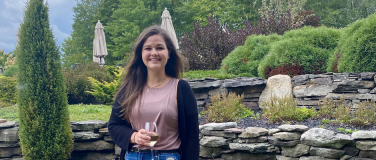


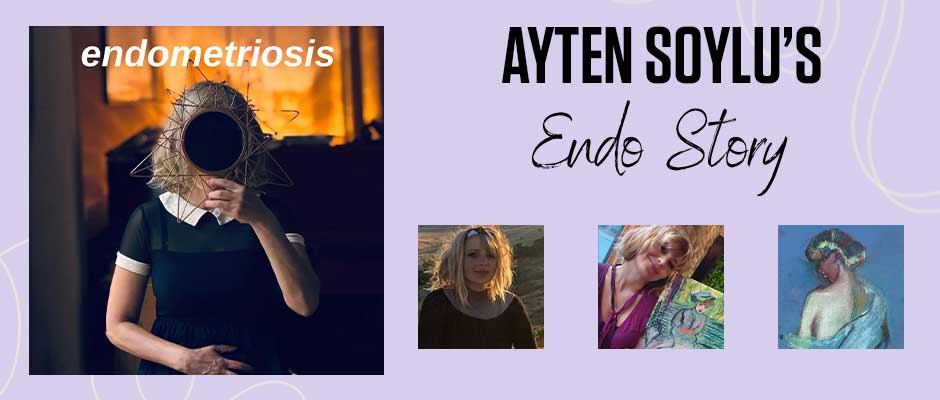
The first six lines of Ayten Soylu’s somber ballad “Breathe” directly and poignantly express what women worldwide with endometriosis are crying out from the depths of their souls:
I want to breathe
Not just survive
Do you hear me?
Do you really care?
Years lost in pain
Fighting to survive
“I wrote the song last year, but I’ve been living it my whole life,” said Soylu, 47. “The only way for me to breathe is to create. I’m writing songs, and I’m painting now, too. If I don’t create in some way, I’ll be worse than I am. I’d be very suicidal thinking about my pain all the time.”
Soylu, a visual artist and musician, is a native of Turkey and a resident of London. When she was 17, she began having painful and irregular periods every 10 to 14 days. X-rays revealed several small cysts in her uterus.
“Their solution was to put me on contraceptive pills to make my periods more regular. This lasted for two years in Turkey,” Soylu said. “When I arrived in London to work as an au pair, I experienced more pain. After visits to doctors a few times, I was prescribed painkillers.”
The medication provided little relief. The pain soon stretched into her back and radiated down her legs. It was unbearable, yet nobody could find a reason for it.
I’m a faded rose
I’m an empty shell
Can you heal me?
Can you feel my pain?
All day and night
Struggling in vain
Over the next two decades, Soylu’s symptoms worsened. Her periods remained irregular, and she lost significant blood with each one. She felt nauseous and frequently vomited after meals. More symptoms, including painful bowel movements, fatigue, urinary tract infections, bloating, painful cramps, and anxiety consumed her daily life. The pain was so intense at times that she passed out. She saw numerous doctors and made several trips to emergency rooms throughout these years. Not one doctor offered to do exploratory surgery, and every diagnosis Soylu received was wrong. One doctor even told her it wasn’t a gynecological issue—it was all in her head.
“I became really depressed,” Soylu said. “All of the doctors I saw were very rude to me. They dismissed me and neglected me during a time when I was so desperate. It’s like they thought I was there because I wanted to be there.”
If only
I could sleep forever
I won’t beg you
Or let the walls come crumbling down on me
Oh can’t you see?
Why can’t you see?
In 2017, Soylu was referred to a gynecologist after her general practitioner found a large fibroid through an ultrasound. In a story that is now the subject of a formal complaint Soylu filed with the National Health Service—England’s publicly funded healthcare system—she said it took more than a year and a half to get an appointment. Even when she got in, she said she had to fight to be heard. Soylu had researched her symptoms and concluded that she likely had endometriosis, a disease she’d never heard of until then. While the gynecologist told her that a fibroid couldn’t cause her symptoms, he also dismissed endometriosis as the cause.
“He just laughed at me,” Soylu said. “He told me that couldn’t be it.”
Of course, Soylu’s self-diagnosis was correct. When the gynecologist finally did surgery to remove the fibroid in August 2019, he found extensive endometriosis on her bowel, which was stuck to her uterus. Soylu said he did an ablation on her bowel—a technique not recommended by EndoFound cofounder Dr. Tamer Seckin—and nothing more.
“He told me that he didn’t even look for more endometriosis,” Soylu said. “You’d think that after finding that much on my bowels, he would look for it in other places, but he didn’t. He didn’t bother to do anything with it.”
When the pain hadn’t subsided after six weeks, Soylu returned to the doctor, only to be told that she should expect her recovery to take six months.
“That’s when things really went downhill,” Soylu said. “I started having panic attacks. I was still in the emergency room a lot, one time for a weekend. Another time, I was in the hospital for five days. I was really shaky and couldn’t eat. I couldn’t live like that anymore.”
Years suffering
Dreams shattering
Vicious cruelty
Empty promises
I barely breathe
Watching my demise
Soylu finally returned to her native Turkey in 2021 to see a doctor there. He swiftly admitted her for surgery.
“He saw what was really going on,” Soylu said. “He found endometriosis everywhere. There were so many adhesions, and all my organs were stuck together. It was a mess. The surgery took four hours, and he removed all of my reproductive organs.”
Soylu returned to England and said she felt lighter. Her vomiting stopped. She felt better than she had in a long while, but she still had significant pain in one spot on her left side. Unable to afford to return to Turkey, she had to rely on medical professionals in England again, and she said nothing had changed in their treatment of her. It took a long time to get another appointment, which was fruitless.
“They did an ultrasound and said the same lesion that was there the last time was still there. They said it looked like it hadn’t been removed and that it might be causing the pain,” Soylu said.
The doctor, however, insisted that he removed it and refused to do surgery again.
“He told me another surgery wouldn’t help and might make me worse,” Soylu said. “He tried to tell me I wasn’t a good candidate for surgery without even listening to me.”
Soon after, Soylu spoke to another doctor by phone and insisted on a laparoscopy, saying to the doctor point-blank, “The only way to diagnose endometriosis properly is laparoscopy. Why don’t you do that?” Soylu said they agreed to do it, but then changed their mind and did an MRI instead.
“The results they sent me of the MRI were that I had a sizable, well-defined tubular structure at 4.7 centimeters on the left side of my pelvis, close to my bladder. They also found dense adhesions in the vaginal vault and on the anterior wall of the rectum, posterior wall of the bladder, and small bowel loops [coiled section of the small intestine],” Soylu said.
“There was no follow-up, as if the results were normal,” Soylu continued. “My general practitioner had to ask the gynecology department to see me to talk about the results, as my symptoms have gotten worse. I am now waiting to be seen at the end of February 2026, which I am afraid will be a repeat of the same story.”
Many of these stories we share at EndoFound end with some semblance of relief or hope. Unfortunately, Soylu’s story is still being written. She said she would come to America for treatment if she could, but she doesn’t have the money to travel, let alone to pay for a surgery. Until she receives the treatment she needs and deserves, she will continue to paint, write, sing, and manage her symptoms the best she can.
As she concludes in “Breathe,” she knows what she wants. She just needs someone who can and will help her.
I want to live!
I know I will survive
Can you hear me?
Can you feel my pain?
All I need now
For you to take my side
And CURE me!
To listen to “Breathe” and watch the video, visit https://youtu.be/EBrIUHglGJ4.
*Patient stories submitted to EndoFound.org are the patient's views, not necessarily those of the foundation. All testimonials are from real patients, may not reflect the typical patient’s experience, and are not intended to represent or guarantee that anyone will achieve the same or similar results.