


On March 4, 2024, Courtney Craig went to her OB-GYN to find an answer for the excessive bleeding and persistent abdominal pain she had been experiencing. After a pelvic examination, she was told everything was normal.
Despite this diagnosis, Courtney felt that something was not right and continued to advocate for herself. An ultrasound two weeks later revealed a six centimeter cyst on her ovary, and endometriosis was mentioned for the first time. Within a month, the cyst had grown to nine centimeters and her doctor scheduled surgery. At that point, her doctor believed that an ovarian cystectomy–a simple outpatient procedure–would relieve her pain.
“I think people’s misunderstanding about the risks and complications are simply a lack of awareness, and I am a prime example of that,” Courtney’s mother, Georgia Craig says. “I had no awareness of endometriosis. I had never heard of ‘frozen pelvis’ or how endometriosis can potentially lead to complications such as bowel obstruction and kidney failure.”


During Courtney’s surgery on May 20th, 2024, her surgeon encountered an unexpectedly complex surgical field. An injury to her iliac vein led to massive bleeding, and Courtney went into shock.
“I answered the phone to hear what I already knew,” Georgia says. “Despite extensive resuscitative efforts, Courtney succumbed to acute blood loss anemia and shock.”
Courtney passed away on the same day as her surgery. “There was a hidden enemy,” Georgia says. “An undiagnosed case of advanced endometriosis.”
Like millions with endometriosis, Courtney’s symptoms began quietly and were easily explained away: heavy, painful periods; digestive issues; extreme fatigue; bladder pain mistaken for recurrent UTIs; and anxiety and depression that worsened premenstrually.
This is how endometriosis goes undetected—not because it is rare, but because it shares symptoms with other conditions—and thrives in a system not designed to look for it.
Lack of Training
“I can’t stress enough that most general OB-GYNs lack extensive endometriosis training,” Georgia says. At the time, her family felt confident that Courtney was receiving appropriate care by her OB-GYN for her symptoms. Looking back, Georgia explains, one of Courtney’s texts stands out painfully: “Nobody seems concerned about the stomach pains.”

While endometriosis is commonly associated with painful periods, about 90% of patients with endometriosis experience gastrointestinal (GI) symptoms, including bloating, diarrhea, constipation, nausea, and abdominal pain. These symptoms are often attributed to irritable bowel syndrome (IBS), and many doctors do not correlate pelvic pain with abdominal pain—an oversight that contributes to the diagnostic delay. Research shows that these symptoms frequently co-occur, with patients with endometriosis being two-three times more likely to be diagnosed with IBS.
“Most general OB-GYNs may not recognize complex presentations, because they are not adequately trained,” Georgia explains. Endometriosis excision is a major abdominal surgery. The disease can cause adhesions (bands of scar tissue that bind structures together that are not meant to be connected) which can distort anatomy and obscure major blood vessels and nerves, significantly increasing surgical risk.
Because there is no reliable, non-invasive diagnostic test for endometriosis, surgeons often enter the operating room without knowing the extent or location of the disease. Even the most experienced surgeons who specialize in laparoscopic excision surgery will only be able to have an informed theory as to the extent of endometriosis lesions as well as their location. Due to this uncertainty, endometriosis specialists often work with a multidisciplinary team and use preoperative planning to anticipate where lesions might be and how to excise them safely and thoroughly.
Yet, patients are rarely prepared for this reality. “Courtney’s endometriosis was never diagnosed,” Georgia shares. “The autopsy surgeon said Courtney’s endometriosis was so advanced, and her pelvis so frozen, that she and her assistant had difficulty performing their post-mortem tasks.”
This raises a critical question: How can a patient advocate for something they have not been taught to suspect?
The Cost of Diagnostic Delay
It takes an average of seven years to be diagnosed with endometriosis. This is due, in part, to normalization of symptoms and limited diagnostic options. “In the US, laparoscopic surgery remains the only avenue for a definitive diagnosis,” Georgia says. “Patients need to understand the symptoms and seriousness of endometriosis and other ways of suspecting the disease.”
While imaging tests, like an ultrasound and MRI, cannot confirm endometriosis, expert sonographers use specialized techniques to identify signs of endometriosis. Even then, access remains a barrier. “There are hurdles like pre-authorization, waiting periods, and high out-of-pocket costs,” Georgia adds.
This illuminates a very common problem people experience accessing endometriosis care: the system is segregated and insurance and health care systems dictate the steps people can take to access that care. Wait times to see a specialist can exceed a year, and some may have to travel across state lines or internationally. For a disease affecting one in ten women, the scarcity of specialists is striking and concerning.
Ultimately, the root of the issue is awareness. “Doctors can’t treat endometriosis without knowing that their patients have it and to what degree. Patients can’t make smart health decisions if they are not aware of the pervasiveness, seriousness, or levels of treatments required,” Georgia says.
Awareness and Advocacy: Events You Can Join
After Courtney passed away, Georgia wanted to help ensure such a devastating and undeserved complication did not happen to anyone else. “I asked myself how I could help millions of women with a serious disease that is extremely pervasive, yet underfunded, under-researched and grossly non-diagnosed,” Georgia shares.
Her answer has been advocacy. Since Courtney’s death, Georgia has become one of the Endometriosis Foundation of America’s leading fundraisers, channeling her grief into action to help raise awareness and research funding for endometriosis.
In honor of Courtney’s love for movement and community, Georgia created Team Courtney, a collective of runners, walkers, hikers, bikers, surfers, skiers, and supporters who, in participating in activities Courtney loved, raise critical awareness and funds towards EndoFound’s signature fundraising campaign to “End Endo.” Rooted in Courtney’s spirit of turning setbacks into motivation, Team Courtney is a powerful, inclusive way for others to carry her legacy forward.
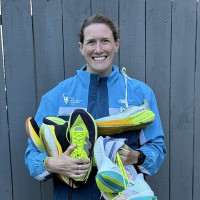
Courtney’s entire family is committed to fundraising in honor of Courtney. For the Parkway Subaru Battleship Half Marathon in Wilmington, NC, Courtney’s older sister Casey also organized a "Running for Courtney" team. As Casey describes the event, there were many new runners who, inspired by Courtney's own running journey, trained, prepared and pushed themselves to new limits, just as Courtney had. “We had veteran runners who felt a new sense of inspiration this go around, telling us how spiritual this race was for them,” Casey shares. Most notably, she adds, was the number of women who came up to their team because of their poster featuring Courtney and her endometriosis story. “They wanted to thank us and share their heartbreaking endo stories, which are sounding all too familiar."
With upcoming corporate matching, Georgia expects to raise $19,500 on Courtney’s Endometriosis Foundation of America page, funding that supports the urgent need for national awareness and proper diagnosis for the disease.
“Each day I challenge myself to live up to one of Courtney’s favorite quotes: ‘Be the reason why someone feels included, welcomed, supported, safe and valued,’” Georgia says.
Georgia’s advocacy, inspired by Courtney’s intolerance for injustice, shows what becomes possible when grief is turned into action. You don’t need the loudest voice to make an impact. Sharing your story might be the tipping point that makes someone pause, seek a second opinion, and truly understand what endometriosis is.
As Georgia puts it, It’s what Courtney would do.