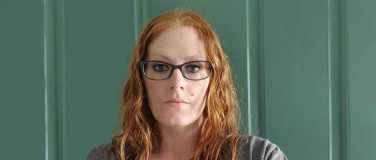


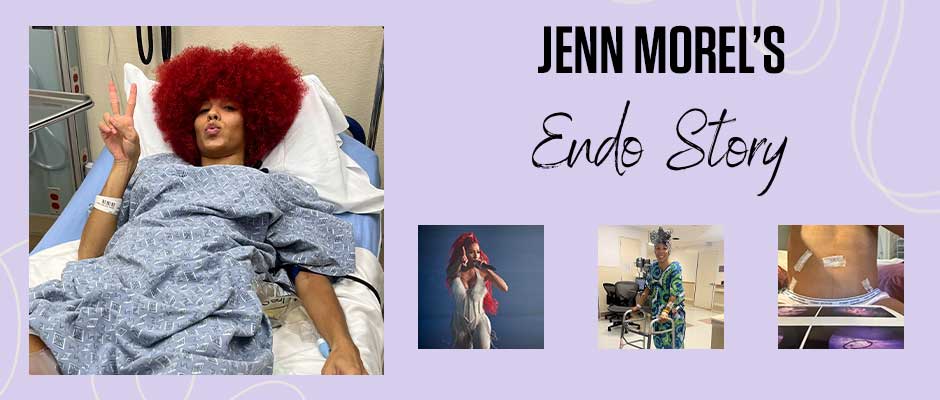
Jenn Morel’s joy during a phone conversation last month was infectious. Her positive energy palpable. Her humor sparkling. These attributes were somewhat astonishing considering the pain she was in just seven months ago that halted her music career, the complications following her endometriosis surgery, and the nephrostomy bag that’s still attached to her.
“As a performer, as a recording artist, your image is very important, but I’m wearing my battle scars proudly and am excited to be an example for other girls!” Morel exclaimed. “It’s not about being cute and being onstage. It’s knowing that you went through hell, you’re still showing up, you’re telling your story, and you’re being true to yourself.”
Born in the Dominican Republic, Morel came to the United States when she was six. She grew up in Harlem and lived there until she was 23 before moving to Los Angeles, where she resides today. The rapper, singer, and songwriter had endometriosis symptoms for nearly 20 years.
“I was a late bloomer. I didn’t get my period until I was 16, and I was in a lot of pain right from the start,” she said. “I used to see my mom have a lot of pain at her time of the month, and I said, ‘Okay, cool, I guess this is just how we have to live. Take a pill, pick up the pieces, and I’ll be alright.’ My mom would hand me a Tylenol or Advil, and I’d go about my day.”
As the pain intensified over the next six years, Morel saw several doctors, but none had answers for her.
“It was horrendous in college,” she said. “I’d get up in the morning, go to school, and take pills all day. For that one week every month, that was my life.”
With New York doctors insisting that her periods were normal, Morel flew to the Dominican Republic to see her mother’s gynecologist, the one who delivered Morel and her siblings.
“He did a couple of exams and said, ‘Have you ever heard of endometriosis?’ I hadn’t,” Morel said. “He explained the pain to me and how it happens during your period and stays inside of you. That’s when I started researching it more and knew that’s what I had.”
The doctor prescribed Morel birth control pills, and she would continue to get prescriptions for them from California doctors when she moved there a year later in 2014.
“It helped, but I knew deep inside that something wasn’t right,” Morel said. “The birth control was just a bandage.”
That bandage would hold for nearly a decade, long enough for Morel’s star to rise.
In 2016, after appearing as a dancer in music videos for performers such as Nicki Minaj and Drake, Morel’s own singing career took off. She gained some popularity on the East and West coasts of the U.S., but her Latin sounds were an instant sensation in Europe and other parts of the world. She toured regularly in countries like Spain, France, and Italy. Her debut single, “Ponteme,” reached No. 3 on the Italian music charts in 2017 and is now a 2X platinum-certified record. She performed at EDC Mexico in front of 100,000 people. Today, she has roughly 700,000 followers across various social media platforms.
But behind the scenes, her suffering lingered.
“The traveling for my shows was so bad,” Morel said. “My brother, Joelii, works with me, and there were times when he’d have to do the soundchecks for me while I was on the floor in the green room in excruciating pain. Or he’d have to carry me into or out of a show. I’d have to take a bunch of ibuprofen just to cope, to be able to get up there on stage with a smile on my face.”
On August 3, 2025, Morel performed at Zumba’s ZINCON event in front of 8,000 fans in Orlando, Florida. She said it was “an amazing show” in what had been an “iconic” year for her, but she couldn’t perform any longer.
“After that show,” she said, “my body was done.”
An MRI revealed what appeared to be significant endometriosis. Morel had surgery on August 29. The operation took nine hours.
“I was in stage IV. It was so intense,” Morel said. “They took my appendix. They cut out two inches of my colon. I lost one of my fallopian tubes. I had lesions on my ureters, vagina, rectum, and even my diaphragm. The disease was literally infiltrating nearly all of my organs and had taken over my body. How in the world had I been surviving for so long on ibuprofen and birth control?”
Though Morel’s years of pain subsided following surgery, she had a major complication a week later when her temperature spiked to 101.4. Doctors found a small puncture in one of her ureters, which had occurred as they were excising the endometriosis. Morel has worn a nephrostomy bag since, which she affectionately named Cathy (for “catheter”). It will be removed in April.
“This entire experience changed my life and made me realize that I have to take charge of myself,” Morel said. “I’m so humbled and honored to be able to tell my story so that other girls and women can have an understanding of their bodies. I’ve shared photos of my belly scars on social media, and at times I’ve thought of them as the ugly truth about surgery. But within that perceived ugliness, there is something profoundly beautiful—healing, strength, and the gift of health.”
Building on this transformation, Morel wants every girl and woman to know they deserve to be heard and have options.
“You have the right to do your own research and find doctors who will listen to you,” she said. “Read the reviews and see what they’re all about and what they stand for. Also, understand that there will be a lot of ignorance around this disease. Don’t let someone tell you it’s just period pain and to toughen up. No, you have period pain and need help. I don’t see acknowledging the pain as a weakness, but as a strength that will help you figure out what you have and how you can have a better life in the long run.”
During her recovery, Morel said her fans have been clamoring for a return date to the stage.
“My endometriosis pain is gone, and I will say bye-bye to Cathy in April when they remove her,” she said enthusiastically. “So, God willing, I’ll be ready to tour again in June.”
*Patient stories submitted to EndoFound.org are the patient's views, not necessarily those of the foundation. All testimonials are from real patients, may not reflect the typical patient’s experience, and are not intended to represent or guarantee that anyone will achieve the same or similar results.