

Blossom Ball 2025 - Endometriosis Foundation of America
May 15, 2025
Pierre Hotel in New York City
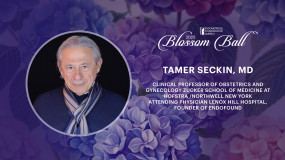
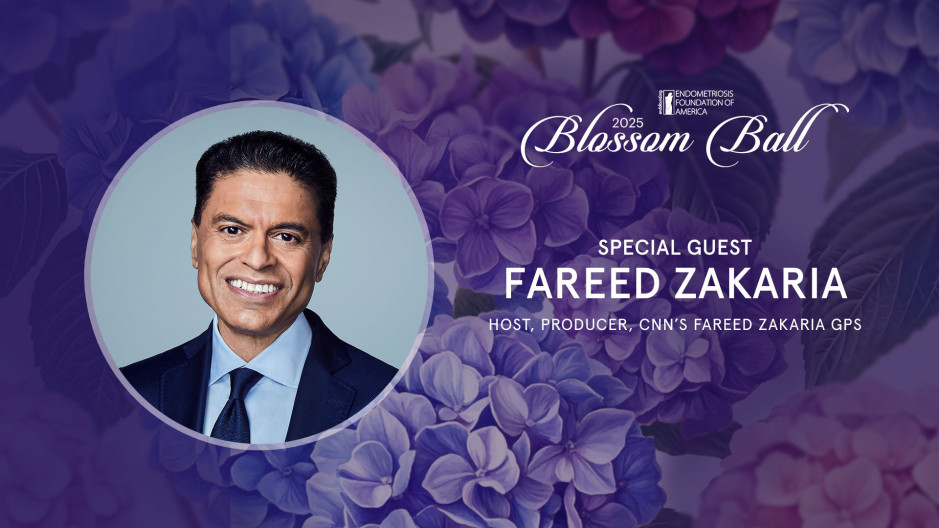
It is my really great pleasure and personal honor to introduce someone who has been part of the EndoFound journey from the beginning, Fareed Zakaria. He joined us at the first Blossom Ball in 2009, and here he is again, 17 years later, continuing this journey with us. That kind of loyalty and belief in our mission means so much to the world, to me, and to this community.
Fareed is one of the most respected voices in global affairs. He hosts CNN’s flagship international program, Fareed Zakaria GPS, which I always watch. He is also a columnist who writes beautifully for The Washington Post and The New York Times. He has earned a Peabody Award, two Emmys, and the Padma Bhushan, one of India’s highest civilian honors.
But beyond his incredible accolades, Fareed has always been a thoughtful and compassionate friend to this cause, supporting EndoFound with sincerity and purpose from the very beginning. Tonight, as we reflect on how far we have come and the work still ahead, I cannot think of a more fitting voice to guide us forward.
Please join me in welcoming Fareed Zakaria.
Thank you. Thank you so much, Dr. Seckin. I have to call him Dr. Seckin — that’s the only thing I’ve ever known him as.
So why was I the keynote speaker at the first Blossom Ball, and why was I supporting endometriosis? For the reason that men often do good things in life: my wife asked me to do it. And she’s here now. Now my ex-wife — she came to her senses — but she’s still here to honor and support. The one thing we both still deeply believe in together is Dr. Seckin and endometriosis.
But it’s a fascinating example of how you get involved in things serendipitously, accidentally, and then how it takes on a larger hold in your life. Because once we got involved, we learned that Dr. Seckin was not just Paula’s OB-GYN — he delivered our youngest child — but we also got to know somebody else, a good friend who was another patient of Dr. Seckin’s, who had some very difficult troubles with endometriosis, which Dr. Seckin miraculously was able to handle.
And then we stayed involved because Dr. Seckin is such a charismatic and interesting person, and he became a friend. Paula, in particular, stayed deeply involved.
But then one day, our second child, Lila, came to us and described the fact that she was having painful periods. After a while — a year or two — she finally decided she really wanted to get that examined. She went to an OB-GYN in New York, and he said to her, “Your ovaries are covered with this stuff. I don’t know what to do. I’m sorry, this is beyond my pay grade.”
And she came and told us, and we had this moment you have as a parent where you just panic and think to yourself, “How could this happen?” But for us, it was mixed with a strange sense of relief because the minute we heard what she was going through, we knew we had a savior in Dr. Seckin. We knew there was a path forward.
And three weeks later, Dr. Seckin did a five-and-a-half-hour surgery on her, and she’s here now and in fantastic health. Lila, do you want to stand again?
And it’s a moment like that when you realize so many things about life — what is really important to you. You’re going through your life, you have this interesting life and career and friends and travel, and then something like this happens and you think to yourself: no, actually, you have only one thing going on in your life, which is how do you make sure that your child is protected?
And the fact that Dr. Seckin would do something like that is, for Paula and me, a lifesaver — for Lila, of course, a lifesaver.
But the extraordinary thing about Dr. Seckin is that he doesn’t stop at helping one patient, or two patients, or five patients a day. He asks himself: How do you have an impact on a broader scale? How do you do this in a way that transforms thousands and thousands and hundreds of thousands of women’s lives and lived experiences?
How do you take that worry out of the millions of families who worry about this?
And to me, that is the extraordinary quality that Dr. Seckin has. He is a brilliant surgeon, he’s a brilliant doctor, but he is also trying to do something on a much larger scale so that it helps not just his patients, but the patients of hundreds and thousands of doctors all over the world.
And doing that, I think, is the only way you actually change this.
And this experience has made me realize how hard it’s been because we still do live in a man’s world, where women’s diseases are not noticed as much, they’re not funded as much, and things are not organized around them as much.
When we walked into this beautiful banquet hall, Paula and Lila were commenting on how cold it is in here. One was wishing she had brought a shawl, the other was glad she brought a jacket. And I said, “Yeah, because air conditioning is set for men’s clothes. We are sitting in our wool suits and we’re fine.”
But it’s just one more example of how, without even thinking about it, the world is structured in a certain way. And one of the many challenges that endometriosis faces is: how do you give it a profile in a world where so much of the default is still centered around men?
I want to note the extraordinary importance of this ball because it marks the beginning of this new center and this new program. And I think you couldn’t have gotten a better person than Samir, whom we had the honor of exchanging a few words with earlier, because you could tell this is a person truly passionate and dedicated to this idea.
And that’s something you need right now.
Because let’s face it, we are going through a very difficult period in the United States, particularly around the legitimacy of science, the legitimacy of facts, the legitimacy of research. And at a time when all these things are under scrutiny and under pressure, the fact that you have scientists willing to do this kind of work — and to do it no matter what, because this is their calling — that’s what we have to hope for.
Because scientists have gone through this before. Samir was saying they burned the Library of Alexandria, they executed Galileo. Scientists have gone through all this for a very long time. The Scopes Trial on evolution took place in this country.
And you forget: the scientists always win.
At the end of the day, science continues. It perseveres. It expands. Because it addresses the deepest human need for survival and flourishing.
And so it’s all the more incumbent on all of you who are here to try to help Dr. Seckin and Samir. Because at a time when the government is cutting back, when you are finding this extraordinary skepticism, when you have these assaults on science, those of us who have benefited from science — who have benefited from the passion of people like Dr. Seckin and Samir — if we don’t support it, then who will?
So I really do urge you: take this day, and let’s try, at a moment when there are all these pressures, to show that we as people, we as a society, still believe in science. We still have the hope, and we still have the willingness to support this science because we know that it is going to help millions and millions of women for many, many years to come.
Thank you all so much.