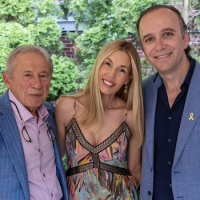


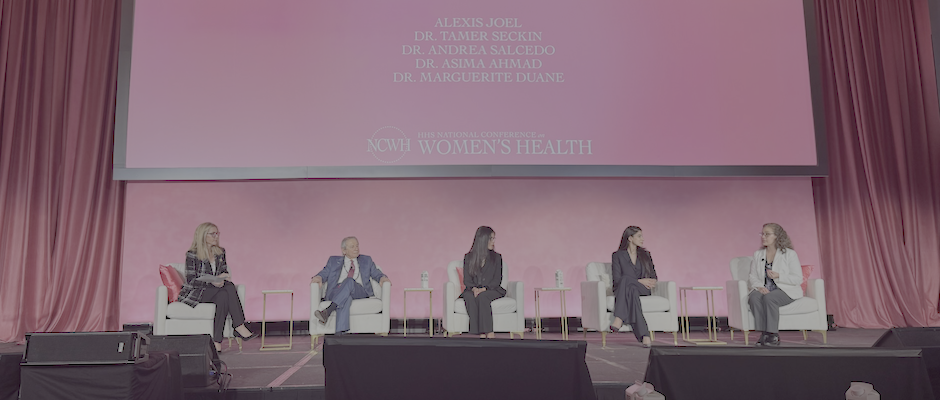
Photo Caption: HHS Speakers Dr. Asima Ahman, Dr. Marguerite Duane, Dr. Andrea Salcedo, and Dr. Tamer Seckin, with moderator Alexis Joel
Last week, EndoFound’s Advocacy Team traveled to Washington, D.C. for a series of meetings and events that marked a meaningful turning point for the endometriosis community. Between participating in the HHS Inaugural National Conference on Women’s Health and conducting a series of meetings and outreach efforts across both the House and Senate, as well as longstanding leaders in women’s health policy across federal agencies and key members of the Health Committees, we returned energized by something the endometriosis community has been working toward for a long time: real, sustained attention from those who shape national policy in women’s health.
At the Inaugural National Conference on Women’s Health
The week began at the HHS Women’s Health Conference, hosted by the U.S. Department of Health and Human Services Office on Women’s Health. Held at the Omni Shoreham Hotel in Washington, D.C., the conference brought together researchers, clinicians, policymakers, advocates, and federal health leaders for three days and focused on breakthroughs in the research, prevention, diagnosis, and treatment of conditions affecting women across the lifespan. For EndoFound, it was an extraordinary opportunity to be in the same room as organizations shaping national women’s health policy, and to make sure endometriosis was part of this critical conversation.
EndoFound CoFounder and internationally recognized endometriosis surgeon Dr. Tamer Seckin participated as a featured speaker on a panel concerning infertility and endometriosis. “Addressing Chronic Conditions in the Evaluation of Infertility” was moderated by Chair of Advocacy & Strategic Partnerships for EndoFound Alexis Roderick Joel, focusing on the intersection of infertility and conditions like endometriosis that too often go undiagnosed for years.
Over in the conference’s poster hall, our Director of Community Health Programs Carolyn Mayer and Community Health Program Coordinator Isabella Wegner presented on ENPOWR, our signature school-based education program designed to reach young people before years of pain and misdiagnosis become their norm. The response from the conference attendees was very positive, Wegner shares, adding that “conference attendees were excited about our work and eager to learn how they could get involved.”
Bringing ENPOWR to a national federal health conference is a reminder of what education-first advocacy looks like in practice: meeting patients where they are, as early as possible, with the information that could change the course of their lives.
A Clear and Growing Understanding that Endometriosis is Not a Niche Issue
The Hill meetings were productive on every front: an opportunity to formally introduce endometriosis to new congressional offices, explore pathways to funding, and map out future legislative possibilities. We shared basic and comprehensive information about the disease, including barriers to diagnosis and treatment, as well as news concerning the latest cutting-edge developments in research that could change the lives of patients at the heart of this work. What we heard in return, consistently and across the aisle, was a growing recognition that endometriosis is indeed a public health crisis.
This consistency of disease recognition across meetings is very encouraging. As Joel describes it: “The level of engagement we saw, from Congressional offices to long-standing policy leaders, signals that this issue is being taken seriously at the highest levels. The bipartisan interest and cross-administration continuity reflect a shared acknowledgment: women’s health, and specifically endometriosis, is an imminent public health crisis requiring coordinated, sustained action.”
Wegner agrees, adding just how heartening every interaction was with office staff, who were across the board extremely enthusiastic about scheduling meetings and learning more about endometriosis.
That acknowledgement matters, because for too long, patients have had to fight simply to be believed. Hearing this echoed back from congressional offices—unprompted, repeatedly—is the kind of shift that can make a critical difference.
“We’ve seen important progress in recent years,” EndoFound Managing Director Jeanne Rebillard adds, “including increased attention and funding for endometriosis, which is encouraging. But when you look at the scale of the disease—impacting one in ten women and still taking an average of 7 to 10 years to diagnose—it’s clear that investment has not yet met the true scope of patient need. At the same time, we are seeing meaningful momentum at both the federal and state levels, which is incredibly encouraging and signals that real change is within reach.”
A New Co-Chair for the House Endometriosis Caucus
Among the week’s most significant milestones: U.S. Representative Diana Harshbarger (R-TN) officially joined the bipartisan House Endometriosis Caucus as Co-Chair. She joins Representative Nikema Williams (D-GA), who has served as Co-Chair since relaunching the Caucus in November 2021 and has spent over four years working to elevate endometriosis as a national health priority. This is exactly the kind of structural, lasting support that moves the needle for patients—not just awareness in the abstract, but named, committed voices in Congress working together to advance research, education, and policy solutions.
The House Endometriosis Caucus is a bipartisan platform dedicated to educating Members of Congress, elevating patient voices, and advancing policies that improve outcomes for the millions of people living with endometriosis. EndoFound has been a key partner to the Caucus since its inception, helping to champion its initial launch and support its virtual relaunch, while continuing to advance awareness, engagement, and legislative and policy efforts in close collaboration with the House Endometriosis Caucus.
Representative Williams has championed the Endometriosis CARE Act, landmark legislation aimed at expanding federal research funding, reducing diagnostic delays—which currently average 7 to 10 years—improving provider training for earlier diagnosis and more effective treatment, and advancing national standards of care. These are not abstract policy goals. They are the difference between years of suffering and a patient getting answers while there is still time to act.
Representative Harshbarger brings her own patient-centered perspective to her new role: “As a pharmacist for decades prior to serving in Congress, I’ve seen firsthand how often women’s health conditions like endometriosis go undiagnosed or undertreated for far too long. That must change. I’m honored to serve as Co-Chair of the Endometriosis Caucus and look forward to working with Congresswoman Williams and passionate advocates across the country to raise awareness, improve early diagnosis, and advance meaningful, patient-centered solutions for the millions of women affected by this disease.”
The Crisis No One Talks About Enough: Access in Underserved Communities & Rural America
One of the sharpest takeaways from the week was access—or more precisely, the devastating lack of it in rural communities. We often discuss diagnostic delays, and rightly so. But as Joel puts it, “In many communities, patients are not just facing delays in diagnosis. They often cannot access a specialist at all. In some cases, there is no nearby hospital equipped to perform the complex surgeries required for conditions like endometriosis. This reality fundamentally changes outcomes.”
For patients in those communities, the problem isn’t just that diagnosis takes too long. It’s that even after diagnosis, the care they need may not exist within reach. “This is why engagement with the Rural Health Caucus is so critical,” Joel adds. “Expanding access to specialty care, surgical expertise, and appropriate facilities in underserved areas must be part of any serious national strategy.”
Walking the Halls: A Full Circle Moment
For EndoFound Social Media Manager Leslie Mosier, the week carried a personal weight beyond policy. “My first period began here in Washington, D.C. during a school trip,” Mosier shares. “This marked the start of years of pain and being dismissed, before finally receiving an endometriosis diagnosis 13 years later. Walking the halls of the Capitol alongside fellow endo warriors and dedicated advocates and surgeons was a powerful full circle moment. It’s a reminder of why this work matters and how far we still have to go.”
What made last week meaningful wasn’t just the meetings or the policy wins; it was the knowledge that every step taken in those halls was taken on behalf of patients—those still waiting for care, for answers, and for someone to listen.
The Work Continues
We came home from Washington with a full agenda: deepening relationships across Congress, pursuing funding pathways, advancing research, and continuing to push for equitable access to care in every corner of this country. The awareness and support we have worked so hard for as a community are starting to make a difference. Now our focus, collectively, must shift to implementation.
“What we’re seeing now is a shift from awareness to action,” Rebillard shares. “The conversations we had in Washington are opening doors to research, education, and policy solutions that can truly change outcomes. This momentum is driven by our community—by patients who have shared their stories, raised their voices, and refused to be overlooked. Our focus now is to build on that energy and ensure that every patient, no matter where they live, has access to timely diagnosis, expert care, and the support they deserve.”
To every patient who has shared their story with us, who has shown up at events, who has trusted EndoFound to carry this work forward, this trip was for you. We are grateful, and we are not done. If you’d like to get involved in advocacy, you can learn more about our efforts here. Or dig into The Advocacy Toolkit, which makes it easy to start making an impact for those with endometriosis.