

What is endometriosis?
Endometriosis is not simply a "menstruation disease," it is a complex systemic disease associated with tissue similar to the endometrial lining of the uterus growing outside the uterus that can affect the whole body.
The disease is characterized by lesions called implants, nodules, or endometriomas that can respond to monthly fluctuations of hormones (estrogen and progesterone) during the menstrual cycle. During this cycle, estrogen can cause this out-of-place tissue to grow, often causing severe pain.
Endometriosis is associated with immune and hormonal disruptions. As endometriosis grows, it causes inflammation, which can lead to adhesions, scarring, internal bleeding, bowel or urinary dysfunction, constipation, painful intercourse, or infertility. The physical pain can be severe, which can lead to psychological distress. It’s a combination that, in many ways, can have a debilitating effect on an individual's life.
When the immune and clearance systems are adequate, an individual can have endometriosis, but it can be inactivated. A surgeon may coincidentally find the disease in these patients while performing another surgery, such as tubal ligation. When found inactive, it has less than a 10 percent chance of being associated with future problems. However, long-term monitoring will be needed and can include exams and ultrasound or MRI imaging.
Endometriosis affects an estimated 200 million women and those born with a uterus worldwide and more than 1 in 10 in the U.S. It affects patients from all racial, ethnic, and socioeconomic backgrounds. There is no known cause of the disease and no cure, though it is treatable. Because of the lack of education about endometriosis, pain or other symptoms are often dismissed as “part of being a woman” or misdiagnosed. This often causes a delay of a decade or more in receiving the proper diagnosis of endometriosis.
Where can endometriosis be found?
Generally, endometriosis is found in the pelvic cavity. It can attach to any female reproductive organs, including the uterus, fallopian tubes, ovaries, uterosacral ligaments, or peritoneum. It can also affect the bowel, bladder, intestines, appendix, rectum, or leg nerves or settle into spaces between the bladder, rectum, uterus, or vagina. In rare cases, endometriosis can spread outside the pelvic region into the kidneys, lungs, diaphragm, or brain.
At what age does endometriosis affect individuals?
Endometriosis can affect an individual before the start of the first period. For some, that can be during their pre-teen years. Many individuals with endometriosis will experience symptoms that intensify in high school and college. The majority will be affected most severely in their 20s and 30s.
What impact does endometriosis have on someone's life?
Endometriosis can impact all aspects of someone's life.
- Endometriosis can impact all aspects of someone's life.
- It can interfere with attending school and participating in athletics or other extracurricular activities.
- It can alter career choices or even force someone to give up a career.
- It can affect finances as one struggles to get a proper diagnosis or treatment or as it interferes with work.
- It can impact relationships with romantic partners, friends, or family members who don’t understand the disease and its effects.
- It can lower self-esteem. Many people who are uneducated about the disease, including some doctors and other health care professionals, will dismiss menstrual pain as being “normal” or claim that it’s all in their head.
Pregnancy cures endometriosis.
There is no cure for endometriosis. Symptoms are usually reduced during pregnancy because of increased progesterone in the body.
What are the possible causes of endometriosis?
Multiple theories regarding the cause of endometriosis exist, but no proven causes can adequately explain every aspect of the disease. Below are some of the proposed theories and beliefs regarding endometriosis:
-
Retrograde menstruation is one possibility that can cause endometriosis. Dr. John Sampson first suggested it. Retrograde menstruation is when the endometrium tissue inside the uterus that should be carried out of the body during menstruation instead flows back into the body through the normally open fallopian tubes, allowing the tissue to implant on organs. Although 90 percent of women and those born with a uterus have retrograde menstruation, only one in 10 are diagnosed with symptomatic endometriosis. A possibility for these numbers is that the immune and clearance systems is operating customarily in most indivudals. More research is required to determine why retrograde menstruation affects individuals differently.
-
Müllerian remnant theory suggests that endometriosis precursors can be present during fetal development. It remains dormant until it is activated and transforms into endometriosis at puberty, when estrogen levels increase in the body and menstrual periods begin.
-
Coelomic metaplasia and stem cell transition are theories that suggest non-Müllerian cells can differentiate into endometriosis. Coelomic cells include the peritoneum. Bone-marrow stem cells may help repair multiple tissue types.
-
There is likely a genetic component to endometriosis. Girls with a close female relative with endometriosis are three to seven times more likely to have it themselves. That increased likelihood is an absolute increase of 3 to 6 percent. However, more research is necessary to fully understand the genetic characteristics of endometriosis.
-
The immune and clearance systems and the body’s inflammatory response also contribute to endometriosis or its control, although these mechanisms are poorly understood.
-
Endometriosis is not contagious and cannot be passed from person to person through contact.
What are the symptoms of endometriosis?
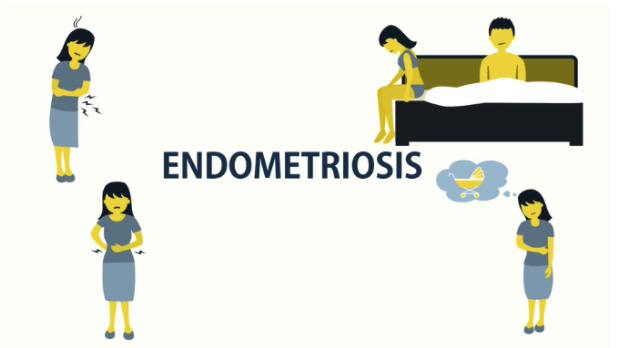
Symptoms of endometriosis can include:
-
Gastrointestinal distress
A hysterectomy will cure endometriosis.
There is no cure for endometriosis, and many patients who undergo a hysterectomy will still experience pain.
How can endometriosis be diagnosed?
-
Laparoscopy and Pathology: The only way to verify pelvic endometriosis is to undergo a diagnostic laparoscopy with pathology confirmation of biopsy specimens. A tiny incision will be made in the patient’s abdomen, and samples of the tissue in question will be removed and sent to a lab to be viewed under a microscope to confirm it is endometriosis.
-
Imaging testing is helpful but not definitive: Despite popular opinion, clear evidence of endometriosis in any form is not visible through computed tomography (CT), magnetic resonance imaging (MRI), or ultrasounds. While imaging tests, pelvic exams, and rectovaginal exams can indicate suspicion of ovarian and deep endometriosis, they cannot confirm it. Nevertheless, it is common practice to obtain a pelvic ultrasound and MRI before undergoing laparoscopic surgery for endometriosis, as these can help plan the surgical approach.
-
Lab testing does not test for endometriosis. There is no blood, urine, or saliva test. Scientific studies are being conducted using circulating miRNAs, anti-Mullerian hormone (AMH), CA-125, cytokines, growth factors, BCL-6, other inflammatory markers, genomics, and epigenomics to test for endometriosis in labs, but more research is needed.
-
The big issue at hand: It takes an average of 10 years from symptom onset to receive an accurate diagnosis of endometriosis in the U.S. This is due to a lack of knowledge among the general public and the medical community. Unfortunately, many endometriosis patients are misdiagnosed, often multiple times, leading to unnecessary and inappropriate treatment. This is why it is crucial to spread further awareness of the disease and support research and funding.
What are common misdiagnoses for endometriosis?
Medical professionals often misdiagnose individuals who have endometriosis for two reasons: they know little about endometriosis because of the lack of focused education in medical schools, and endometriosis symptoms can be similar to those of more common diseases or conditions. Some misdiagnoses individuals receive are irritable bowel syndrome (IBS), appendicitis, ovarian cancer, colon cancer, pelvic inflammatory disease, fibroids, diverticulitis, ovarian cysts, and sexually transmitted diseases. Remarkably, many are also told that the pain they feel is pyschological and that the pain doesn’t exist physically. Rather than treating their physical symptoms, physicians sometimes refer them to a psychologist or psychiatrist.
What are the treatment options?
The gold standard of treatment for deep endometriosis is minimally invasive laparoscopic excision surgery, keeping in mind a few of the following details:

- Deep-excision: Deep excision is performed during laparoscopic excision surgery. The surgeon carefully excises or removes the entire lesion from wherever it is found. This includes the tissue beneath the surface. Deep endometriosis is like an iceberg—despite the disease being identified above the tissue’s surface, the majority is implanted into the tissue below the surface. This is why it is crucial to find a surgeon who removes lesions in their entirety. For information about identifying a proper excision surgeon and preparing for your visit to the doctor, please visit this page.
-
Cold-excision: It is ideal to have surgery with minimal use of heat and electricity. Often, surgeons will use techniques such as ablation (lasers that destroy the disease) or cauterization (burning off the disease) to “burn off and destroy” endometriosis lesions. However, this increases the chance of not fully removing the deep endometriosis lesions and risks damaging surrounding healthy tissue. This does not mean lasers and high-energy devices cannot be used during surgery, as they can often be helpful for coagulation (stopping bleeding). But they should not be used for removing lesions.
-
Other forms of surgery: Ablation and cauterization only remove the tissue on the surface as in superficial endometriosis but neglect the tissue growing beneath the surface. In many cases, ablation or cauterization surgery will not be effective for the long-term management of deep endometriosis. Excess scar tissue can also form using these methods due to the high energy and heat applied to surrounding healthy tissue. In some cases, the inflammation following ablation and cauterization can be another source of pain. This is why excision surgery is the gold standard for treatment. If a patient is considering surgery, they must ask their surgeon about the removal method.
-
Hysterectomy: It is a common myth that having a hysterectomy will cure endometriosis. There is no cure for endometriosis, and a hysterectomy is rarely the best treatment. Most endometriosis is located in areas other than the reproductive organs. If you simply remove the uterus and do not excise the remaining lesions on other organs, the patient will continue to have pain. Decisions regarding a hysterectomy should be made with a doctor experienced in treating endometriosis and should only be performed if agreed upon by the patient. Although a hysterectomy does not cure endometriosis, some patients with endometriosis also have adenomyosis. A hysterectomy can cure adenomyosis, and if it is the major part of the problem, give significant relief. For more information, see “Endometriosis and Hysterectomy.”
How can symptoms be managed?
-
Treating the symptoms, not the cause: There are many ways to relieve endometriosis symptoms, but these options do not treat the endometriosis itself. Instead, they alleviate some of the symptoms caused by the condition. These include:
-
Low-dose oral contraceptives
-
Hormonal intra-uterine device (rather than copper)
-
Painkillers, such as non-steroidal anti-inflammatory drugs (NSAIDs)
-
Hormone (GnRH) therapy
-
Acupuncture
-
Changes in diet
-
Not everyone is the same: While all the above options could relieve symptoms, every patient will benefit differently from each treatment. What may work for one patient may not for another. Endometriosis still requires much more research and knowledge. Each patient must trust their own judgment, work with their physician, and find a pain management strategy that works best for them if they explore alternative treatment measures.
References
-
Endometriosis Definition, Stages, Symptoms, Causes, Diagnosis, and Treatment, Seckin Endometriosis Center
-
Sampson JA. Perforating hemorrhagic (chocolate) cysts of the ovary: their importance and especially their relation to pelvic adenomas of the endometrial type ("adenomyoma" of the uterus, rectovaginal septum, sigmoid, etc.) Trans Am Gynecol Soc 1921;46:162-241.
-
Sampson JA. Peritoneal endometriosis due to the menstrual dissemination of endometrial tissue into the peritoneal cavity. Am J Obstet Gynecol. 1927, 14(4):422-469, doi: 10.1016/S0002-9378(15)30003-X.
-
D'Hooghe, T.M., et al., Endometriosis and subfertility: is the relationship resolved? Semin Reprod Med, 2003. 21(2): p. 243-54.
-
Goud, P.T., et al., Dynamics of nitric oxide, altered follicular microenvironment, and oocyte quality in women with endometriosis. Fertil Steril, 2014. 102(1): p. 151-159 e5.
-
Seckin, T., The Doctor Will See You Now: Recognizing and Treating Endometriosis. 2016.
-
Moen MH, Stokstad T. A long-term follow-up study of women with asymptomatic endometriosis diagnosed incidentally at sterilization. Fertil Steril. 2002, 78(4):773-6. doi: 10.1016/s0015-0282(02)03336-8. PMID: 12372455.
-
Fedele L, Bianchi S, Zanconato G, Raffaelli R, Berlanda N. Is rectovaginal endometriosis a progressive disease? Am J Obstet Gynecol 2004b, 191:1539-1542. doi: 10.1016/j.ajog.2004.06.104. PMID: 15547522.
-
Marsh EE, Laufer MR. Endometriosis in premenarcheal girls who do not have an associated obstructive anomaly. Fertil Steril. 2005 Mar;83(3):758-60. doi: 10.1016/j.fertnstert.2004.08.025. PMID: 15749511.
-
Simpson JL, Bischoff FZ, Kamat A, Buster JE, Carson SA. Genetics of endometriosis. Obstet Gynecol Clin North Am. 2003 Mar;30(1):21-40, vii. doi: 10.1016/s0889-8545(02)00051-7. PMID: 12699256.